The playoffs are well underway in every division of college football except the FCS. And now that North Central got bounced badly, I can turn my full attention to basketball and the Death to the BCS Playoffs.
The regular season is over for all but one conference, plus some assorted other games including the Army-Navy game that's not going to have any playoff impact. So with the conference title games taking place this coming weekend, I need to do one final mock bracket.
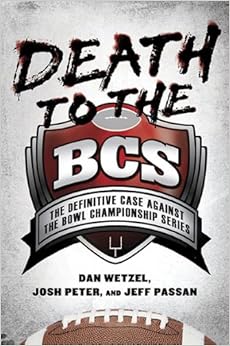
This is for the playoff system created by Dan Wetzel, Josh Peter, and Jeff Passan in the pictured book where there's a 16 team field: 10 automatic bids to every conference champion, plus six at larges to fill the field. They are seeded 1-16, with home field advantage going to the higher seed for the first three rounds before the title game is held in college football's mecca: Pasadena.
So how do we fill the field, and how is it seeded? Ideally, this would be done by committee, but since we don't have a committee for this, I take that responsibility on, though I don't just do it based on the eye test. I use a number of metrics to help me make the right decision. I glance at Non-Conference Schedule Strength (NCSS) to get a measurement of whether teams are trying to challenge themselves out of their conference schedule (and it also gives me an excuse to call Nick Saban a coward). More importantly, I care about results. That's where First Degree (PP1), Second Degree (PP2), and Adjusted Playoff Points (aPP) come in. Those factor in who you beat, and also a little bit of who they beat as well as the Adjusted points factoring in losses. This helps differentiate between 10-2 teams or 11-1 teams. Finally, to help factor in margin of victory and create a lack of bias, I also look at computer rankings devised by Jeff Sagarin (SAG), the late David Rothman as compiled by a UCLA staff member (ROTH), and from the website All My Sports Teams Suck (AMSTS). These factors, along with factors like head to head victories and wins over other playoff teams combine organically to build the bracket.
And so, with that explanation out of the way, let's look at our final mock bracket for this season.
The (mostly) sane rantings of a broadcasting graduate working in sports.
Showing posts with label mock. Show all posts
Monday, November 27, 2017
Monday, November 20, 2017
2017 Death to the BCS Playoffs: Week 12 Mock Bracket
Over in Division III of the NCAA, Saturday was the first round of the playoffs, North Central is still alive as one of the top 16 teams in the country. It's a shame that in reality, a 16 team bracket at the FBS level is nothing more than a pipe dream because of corruption and greed. That's where I'm glad Dan Wetzel, Josh Peter, and Jeff Passan wrote the book pictured here.
In this 2010 (and updated in 2011) classic they tear the old Bowl Championship Series apart piece by piece and introduce their replacement plan, which I've adopted as my pick I'd advocate for: a 16 team field where every conference gets its champion in automatically. The rest of the field is filled with deserving at large candidates, and home field advantage reigns for the first three rounds.
The at large selections and seeding processes are suggested to be done by a committee. Since said committee doesn't exist, I try my best to be the committee and build out this scenario to the best of my ability. To do so, I use a number of metrics. I start with a casual look at Non-Conference Schedule Strength (NCSS), which gives a score based on what that schedule looks like. More points are awarded for road games and/or games against Power Five schools, while teams get penalized for playing down a level, though they don't get soapboxed unless you're one of the five schools full of cowards this past week. More importantly, I look at First Degree, Second Degree, and Adjusted Playoff Points (PP1, PP2, aPP, respectively) as a way of looking beyond records to how good the teams you beat were. Finally, to help reduce bias, and also to factor margin of victory in, I use three sets of computer rankings: Jeff Sagarin's (SAG), those compiled by a UCLA staffer using the late David Rothman's formula (ROTH), and those from the website All My Sports Teams Suck (AMSTS).
These factors all somewhat organically combine to build the field. So without further ado, here is my penultimate 2017 mock bracket.
In this 2010 (and updated in 2011) classic they tear the old Bowl Championship Series apart piece by piece and introduce their replacement plan, which I've adopted as my pick I'd advocate for: a 16 team field where every conference gets its champion in automatically. The rest of the field is filled with deserving at large candidates, and home field advantage reigns for the first three rounds.
The at large selections and seeding processes are suggested to be done by a committee. Since said committee doesn't exist, I try my best to be the committee and build out this scenario to the best of my ability. To do so, I use a number of metrics. I start with a casual look at Non-Conference Schedule Strength (NCSS), which gives a score based on what that schedule looks like. More points are awarded for road games and/or games against Power Five schools, while teams get penalized for playing down a level, though they don't get soapboxed unless you're one of the five schools full of cowards this past week. More importantly, I look at First Degree, Second Degree, and Adjusted Playoff Points (PP1, PP2, aPP, respectively) as a way of looking beyond records to how good the teams you beat were. Finally, to help reduce bias, and also to factor margin of victory in, I use three sets of computer rankings: Jeff Sagarin's (SAG), those compiled by a UCLA staffer using the late David Rothman's formula (ROTH), and those from the website All My Sports Teams Suck (AMSTS).
These factors all somewhat organically combine to build the field. So without further ado, here is my penultimate 2017 mock bracket.
Monday, November 13, 2017
2017 Death to the BCS Playoffs: Week 11 Mock Bracket
I mentioned it early this morning, but in case you didn't see, chaos reigned during Week 11 of the college season. There was even a little bit in D-III as well, where the playoff brackets are built, North Central won the CCIW's automatic bid, and until they get bounced in a disappointing Round 2 performance by UW-Oshkosh or something to that effect, all is right with the world.
Meanwhile, the selection committee for the College Football Playoff has a tall task on its hands, but not as tall as I've got. They only have to fill four spots; I have to fill 16. Now what helps is that, per the design created by Dan Wetzel, Josh Peter, and Jeff Passan and perfected in the book pictured here, 10 of those spots go to conference champions, the way God and nature intended, yet is perverted by the greed of the big time conference commissioners. So it is that every year I try to take this system built by these authors, and set up a 16 team playoff the way they intend: seeded and on campuses through three rounds.
The trick is how to build the field. Since I don't have the benefit of a selection committee, I use a number of metrics to try and help myself out. To a very minor extent I look at Non-Conference Schedule Strength (NCSS) to see how tough teams made their out of conference schedules. This is mainly just a look at road/home imbalance and how Power Five teams tend to fill their schedules with home games against Group of Five teams (and tomorrow, you get my best rant of the year as to how Nick Saban is a coward). More weight then gets put on First Degree (PP1), Second Degree (PP2), and Adjusted Playoff Points (aPP). This is basically a tabulation of wins of vanquished teams by a given program, then a deeper look at how good those teams actually were, and then an adjustment to factor in losses. Finally, to make sure I get rid of any bias, I also look at three separate computer rankings: Jeff Sagarin's (SAG), the late David Rothman's via a UCLA staff member (ROTH), and from the website All My Sports Teams Suck (AMSTS).
These factors are all kind of organically combined to build the 16 team field that would decide a national champion. After much consideration, as well as some waiting for computer rankings to update while I was working on this, here is the sixth mock bracket of the season.
Meanwhile, the selection committee for the College Football Playoff has a tall task on its hands, but not as tall as I've got. They only have to fill four spots; I have to fill 16. Now what helps is that, per the design created by Dan Wetzel, Josh Peter, and Jeff Passan and perfected in the book pictured here, 10 of those spots go to conference champions, the way God and nature intended, yet is perverted by the greed of the big time conference commissioners. So it is that every year I try to take this system built by these authors, and set up a 16 team playoff the way they intend: seeded and on campuses through three rounds.
The trick is how to build the field. Since I don't have the benefit of a selection committee, I use a number of metrics to try and help myself out. To a very minor extent I look at Non-Conference Schedule Strength (NCSS) to see how tough teams made their out of conference schedules. This is mainly just a look at road/home imbalance and how Power Five teams tend to fill their schedules with home games against Group of Five teams (and tomorrow, you get my best rant of the year as to how Nick Saban is a coward). More weight then gets put on First Degree (PP1), Second Degree (PP2), and Adjusted Playoff Points (aPP). This is basically a tabulation of wins of vanquished teams by a given program, then a deeper look at how good those teams actually were, and then an adjustment to factor in losses. Finally, to make sure I get rid of any bias, I also look at three separate computer rankings: Jeff Sagarin's (SAG), the late David Rothman's via a UCLA staff member (ROTH), and from the website All My Sports Teams Suck (AMSTS).
These factors are all kind of organically combined to build the 16 team field that would decide a national champion. After much consideration, as well as some waiting for computer rankings to update while I was working on this, here is the sixth mock bracket of the season.
Monday, November 6, 2017
2017 NCAA Death to the BCS Playoffs: Week 10 Mock Bracket
I think we're down to just four weeks of the college football season left, which means there aren't too many mock brackets left to make. But every week, things seem to keep getting more and more confusing in the college football landscape, which makes building these mocks more and more complicated.
If you're unfamiliar with this playoff system, it's pretty simple. It's an expanded version of what college football currently uses, based on the system outlined by Dan Wetzel, Josh Peter, and Jeff Passan in the book pictured here: 16 team playoff, with each conference champion getting an automatic bid, and higher seeds host for the first three rounds. It enhances the college football regular season by attaching meaning to far more games.
Now, to fill and seed the field, the authors wanted a selection committee, and for the purposes of this series of posts, I take on the mantle of selection committee. But I don't just blindly fill the field. I use a number of metrics to help me make my decisions. I look a little bit at Non-Conference Schedule Strength (NCSS) to see how tough of a non-conference slate teams built. More importantly, I look at results based on how good defeated teams are. That's where First Degree, Second Degree, and Adjusted Playoff Points (PP1, PP2, and aPP, respectively), come into play. Then to reduce any bias on my part, I look at computer rankings from Jeff Sagarin (SAG), the late David Rothman via a UCLA staff member (ROTH), and the website All My Sports Teams Suck (AMSTS). These factors all kind of organically combine to create the seedings.
So, without further ado, let's build another mock bracket!
If you're unfamiliar with this playoff system, it's pretty simple. It's an expanded version of what college football currently uses, based on the system outlined by Dan Wetzel, Josh Peter, and Jeff Passan in the book pictured here: 16 team playoff, with each conference champion getting an automatic bid, and higher seeds host for the first three rounds. It enhances the college football regular season by attaching meaning to far more games.
Now, to fill and seed the field, the authors wanted a selection committee, and for the purposes of this series of posts, I take on the mantle of selection committee. But I don't just blindly fill the field. I use a number of metrics to help me make my decisions. I look a little bit at Non-Conference Schedule Strength (NCSS) to see how tough of a non-conference slate teams built. More importantly, I look at results based on how good defeated teams are. That's where First Degree, Second Degree, and Adjusted Playoff Points (PP1, PP2, and aPP, respectively), come into play. Then to reduce any bias on my part, I look at computer rankings from Jeff Sagarin (SAG), the late David Rothman via a UCLA staff member (ROTH), and the website All My Sports Teams Suck (AMSTS). These factors all kind of organically combine to create the seedings.
So, without further ado, let's build another mock bracket!
Monday, October 30, 2017
2017 NCAA Death to the BCS Playoffs: Week 9 Mock Bracket
I think this past weekend was the sort of weekend Dan Wetzel, Josh Peter, and Jeff Passan had in mind when they penned the masterpiece you see to your left. There was a ton of chaos, and so many games with playoff impact were played that invoked said chaos. It's further proof that the playoff system they envisioned enhanced the regular season rather than dilute it.
If you haven't read this book, I highly recommend it. But their basic premise for an ideal playoff is this: 16 teams, with each conference getting an automatic bid for its champion, and the field being filled by deserving at large squads. I love the premise, and as such have tried to fill a bracket with their methodology for the last few years. Here's the best part about it though: higher seeds host for the first three rounds, so we're playing games in iconic stadiums on campus in front of partisan crowds instead of neutral site stadiums that may end up half empty. As such, the regular season really matters, because the difference between a 4 seed and a 5 seed is a second home game.
The tricky part comes in how to fill the field, and then how to seed it. To do that, I use a number of metrics. I begin with a glance at Non-Conference Schedule Strength (NCSS), which is a rough look at how tough of a non-conference slate teams are playing (basically, are they playing road games against Power Five opponents or a bunch of home games against Group of Five teams or FCS opponents). At the end of the day though, results matter. That's where First Degree (PP1), Second Degree (PP2), and Adjust Playoff Points (aPP) come in: they go beyond just a won-lost record and figure out how good the teams they beat truly are. Finally, to help reduce bias on my part and to give additional data points, I consult computer rankings compiled by Jeff Sagarin (SAG), a UCLA staff member using the late David Rothman's formula (ROTH), and from the website All My Sports Teams Suck (AMSTS). These factors all kind of organically combine to build the playoff field.
I'm at the point now where I do a mock bracket every week, at least once I can build it without screwing any undefeated teams out of a spot. With a number of them falling this past week, it may create some at large headaches, but we'll see how it goes!
If you haven't read this book, I highly recommend it. But their basic premise for an ideal playoff is this: 16 teams, with each conference getting an automatic bid for its champion, and the field being filled by deserving at large squads. I love the premise, and as such have tried to fill a bracket with their methodology for the last few years. Here's the best part about it though: higher seeds host for the first three rounds, so we're playing games in iconic stadiums on campus in front of partisan crowds instead of neutral site stadiums that may end up half empty. As such, the regular season really matters, because the difference between a 4 seed and a 5 seed is a second home game.
The tricky part comes in how to fill the field, and then how to seed it. To do that, I use a number of metrics. I begin with a glance at Non-Conference Schedule Strength (NCSS), which is a rough look at how tough of a non-conference slate teams are playing (basically, are they playing road games against Power Five opponents or a bunch of home games against Group of Five teams or FCS opponents). At the end of the day though, results matter. That's where First Degree (PP1), Second Degree (PP2), and Adjust Playoff Points (aPP) come in: they go beyond just a won-lost record and figure out how good the teams they beat truly are. Finally, to help reduce bias on my part and to give additional data points, I consult computer rankings compiled by Jeff Sagarin (SAG), a UCLA staff member using the late David Rothman's formula (ROTH), and from the website All My Sports Teams Suck (AMSTS). These factors all kind of organically combine to build the playoff field.
I'm at the point now where I do a mock bracket every week, at least once I can build it without screwing any undefeated teams out of a spot. With a number of them falling this past week, it may create some at large headaches, but we'll see how it goes!
Monday, October 23, 2017
2017 NCAA Death to the BCS Playoffs: Week 8 Mock Bracket
We're still a little over a month away from Championship Saturday, which means I can't fully prepare an actual playoff bracket quite yet. But it's good to get the practice in, and in an alternate universe where this is the actual playoff format, it's good practice for the selection committee. And so, I undertake my third mock of the season.
This is a playoff system outlined in the book pictured to the left, written a few years back by Dan Wetzel, Josh Peter, and Jeff Passan. The premise of the book is simple: the old BCS system of deciding a national champion was elitist, possibly illegal, and patently unfair. So they came up with a fairer one that enhances the regular season: 16 teams, made up of the 10 conference champions (11 when the book was written), with the rest of the field filled by at large selections. They play with home field advantage for the first three rounds, making the season really mean something, and meaning that my seeding of this tournament needs to be perfect.
To help decide the at large teams and seed the field, I look over scores and try to watch games if I can, but because I can't watch every game, I use several metrics to help me out. To a minor degree I check a team's non conference schedule in the form of Non Conference Schedule Strength (NCSS). At the end of the day though, I'm more concerned about results, which is why hopefully you read today's Playoff Points rankings, where I look at First Degree, Second Degree, and Adjusted Playoff Points (PP1, PP2, and aPP, respectively). That's basically a look at win totals of defeated opponents in a few different ways. You can view a full outline of how that metric works in my season introductory post. Then, to ensure that I eliminate any possible bias I may have, I also check three different computer rankings that factor in margin of victory: Jeff Sagarin's (SAG), the late David Rothman's via a UCLA staff member (ROTH), and from the website All My Sports Teams Suck (AMSTS). These factors are all kind of organically combined to build out a bracket, which you can view the newest mock of after the jump.
This is a playoff system outlined in the book pictured to the left, written a few years back by Dan Wetzel, Josh Peter, and Jeff Passan. The premise of the book is simple: the old BCS system of deciding a national champion was elitist, possibly illegal, and patently unfair. So they came up with a fairer one that enhances the regular season: 16 teams, made up of the 10 conference champions (11 when the book was written), with the rest of the field filled by at large selections. They play with home field advantage for the first three rounds, making the season really mean something, and meaning that my seeding of this tournament needs to be perfect.
To help decide the at large teams and seed the field, I look over scores and try to watch games if I can, but because I can't watch every game, I use several metrics to help me out. To a minor degree I check a team's non conference schedule in the form of Non Conference Schedule Strength (NCSS). At the end of the day though, I'm more concerned about results, which is why hopefully you read today's Playoff Points rankings, where I look at First Degree, Second Degree, and Adjusted Playoff Points (PP1, PP2, and aPP, respectively). That's basically a look at win totals of defeated opponents in a few different ways. You can view a full outline of how that metric works in my season introductory post. Then, to ensure that I eliminate any possible bias I may have, I also check three different computer rankings that factor in margin of victory: Jeff Sagarin's (SAG), the late David Rothman's via a UCLA staff member (ROTH), and from the website All My Sports Teams Suck (AMSTS). These factors are all kind of organically combined to build out a bracket, which you can view the newest mock of after the jump.
Monday, October 16, 2017
2017 NCAA Death to the BCS Playoffs: Week 7 Mock Bracket
Last week I had just enough room in my first mock bracket of the season to squeeze in every eligible unbeaten team. And then, go figure, a bunch of them fell like flies.
This complicates the Death to the BCS Playoff picture, even though we still have a good month and a half of season left to play. Teams will separate from the pack a little bit more, and hopefully things will become easier, but in the meantime, I need the practice for bracket building.
So here's a refresher on how this works. The ten conference champions, along with six at large selections, will be seeded 1-16, with higher seeds getting home field advantage for three rounds. To pick out the at large teams and seed the field, I use several of my own metrics, focusing a little on Non-Conference Schedule Strength (NCSS) and more so on First Degree, Second Degree, and Adjusted Playoff Points (PP1, PP2, and aPP, respectively) to help. Then, to help reduce bias, I use computer rankings that factor in margin of victory created by Jeff Sagarin (SAG), the late David Rothman (ROTH), and the website All My Sports Teams Suck (AMSTS). These factors all get kind of organically combined to build the field. The Rothman rankings are up this week, so unlike last week, all three computer rankings will be under consideration.
So without further ado, let's make a mock bracket.
This complicates the Death to the BCS Playoff picture, even though we still have a good month and a half of season left to play. Teams will separate from the pack a little bit more, and hopefully things will become easier, but in the meantime, I need the practice for bracket building.
So here's a refresher on how this works. The ten conference champions, along with six at large selections, will be seeded 1-16, with higher seeds getting home field advantage for three rounds. To pick out the at large teams and seed the field, I use several of my own metrics, focusing a little on Non-Conference Schedule Strength (NCSS) and more so on First Degree, Second Degree, and Adjusted Playoff Points (PP1, PP2, and aPP, respectively) to help. Then, to help reduce bias, I use computer rankings that factor in margin of victory created by Jeff Sagarin (SAG), the late David Rothman (ROTH), and the website All My Sports Teams Suck (AMSTS). These factors all get kind of organically combined to build the field. The Rothman rankings are up this week, so unlike last week, all three computer rankings will be under consideration.
So without further ado, let's make a mock bracket.
Monday, October 9, 2017
2017 NCAA Death to the BCS Playoffs: Week 6 Mock Bracket
Over the last few years I have come to discover a pattern. By Week 6, enough teams have at least one loss on their resume, which allows me to start thinking about playoff brackets.
The current system set up by the FBS conference commissioners is a decent start. It's a definite improvement over the garbage that was the BCS. If you think the BCS wasn't all that bad, go read the book pictured to the left authored by Dan Wetzel, Josh Peter, and Jeff Passan, then come back and tell me with a straight face that the system was all right. If you do, I will call you a liar, because the BCS was a joke.
And that's what inspired an idea by these three men: building a more equitable playoff for college football, like what is run in the lower divisions of the NCAA. That's basically what I aim to build here.
If you missed my season introductory post where I explained their playoff system, here's the CliffNotes version: 16 teams (all ten conference champions plus six at large) seeded 1-16, with home field advantage granted to the higher seeds for the first three rounds. In their system they had a selection committee, which is a role I've taken by proxy for several years now, and tried to build a bracket based on their specifications.
To do that, I use a number of metrics. To a minor degree, Non-Conference Schedule Strength (NCSS) gets factored in, though its impact is minimal when it comes to filling and seeding the field. More important are First Degree, Second Degree, and Adjusted Playoff Points (PP1, PP2, and aPP, respectively), which dig beyond the won-loss record to get an idea of just how good a team actually is.
Now, I don't want to appear biased, so I also use computer rankings to help me determine if I'm making the right choices, but the computer rankings need to be good. I have found three that factor in margin of victory, which is kind of important when we're trying to figure out how good teams actually are. For the purposes of the Death to the BCS Playoffs, I use Jeff Sagarin's (SAG) model, the late David Rothman's (ROTH) model as compiled by a UCLA faculty member, and the rankings from All My Sports Teams Suck (AMSTS). Currently the Rothman model has no data for 2017, so I'm sticking with just the Sagarin and All My Sports Teams Suck models for now, which is enough to start.
These factors all kind of organically combine to build the field of 16, which will be built out below.
The current system set up by the FBS conference commissioners is a decent start. It's a definite improvement over the garbage that was the BCS. If you think the BCS wasn't all that bad, go read the book pictured to the left authored by Dan Wetzel, Josh Peter, and Jeff Passan, then come back and tell me with a straight face that the system was all right. If you do, I will call you a liar, because the BCS was a joke.
And that's what inspired an idea by these three men: building a more equitable playoff for college football, like what is run in the lower divisions of the NCAA. That's basically what I aim to build here.
If you missed my season introductory post where I explained their playoff system, here's the CliffNotes version: 16 teams (all ten conference champions plus six at large) seeded 1-16, with home field advantage granted to the higher seeds for the first three rounds. In their system they had a selection committee, which is a role I've taken by proxy for several years now, and tried to build a bracket based on their specifications.
To do that, I use a number of metrics. To a minor degree, Non-Conference Schedule Strength (NCSS) gets factored in, though its impact is minimal when it comes to filling and seeding the field. More important are First Degree, Second Degree, and Adjusted Playoff Points (PP1, PP2, and aPP, respectively), which dig beyond the won-loss record to get an idea of just how good a team actually is.
Now, I don't want to appear biased, so I also use computer rankings to help me determine if I'm making the right choices, but the computer rankings need to be good. I have found three that factor in margin of victory, which is kind of important when we're trying to figure out how good teams actually are. For the purposes of the Death to the BCS Playoffs, I use Jeff Sagarin's (SAG) model, the late David Rothman's (ROTH) model as compiled by a UCLA faculty member, and the rankings from All My Sports Teams Suck (AMSTS). Currently the Rothman model has no data for 2017, so I'm sticking with just the Sagarin and All My Sports Teams Suck models for now, which is enough to start.
These factors all kind of organically combine to build the field of 16, which will be built out below.
Monday, November 28, 2016
2016 Death to the BCS Playoffs: Week 13 Mock Bracket
I'm still in a state of mourning, but I'll get over it. Wheaton deserved its win on Saturday. And so did all of the teams who won this past weekend as the Death to the BCS Playoff race gets even more complicated.
If you're unfamiliar with how this works, the Death to the BCS Playoffs are the brainchild of Yahoo! writers Dan Wetzel, Josh Peter, and Jeff Passan. They created a 16 team playoff at the highest level of college football, where all conference champions get an automatic bid, and the rest of the field is filled with at large teams. Those auto bids will all be settled next week: eight conference have a conference championship game, the Big 12 has a de facto championship game based on how the schedule aligned, and the Sun Belt will come down to a couple games and some tiebreakers to determine its champion.
From there, the field gets seeded from 1 to 16, with home field advantage going to the higher seeds for the first three rounds. This means finishing in the top two will net you three home games, a #3 or #4 seeds gets you a pair, and finishing in the top eight gives you one in the first round. These figures all assume, of course, that chalk gets rocked. But how do we decide the seeding? Wetzel, Peter, and Passan's idea was for a selection committee to do so, but in my case, I do it myself with the help of some metrics. I use (to an extent) Non Conference Schedule Strength (NCSS), First Degree (PP1), Second Degree (PP2), and Adjusted Playoff Points (aPP), as well as computer rankings compiled by Jeff Sagarin (SAG), the late David Rothman (ROTH), and the website All My Sports Teams Suck (AMSTS). These metrics all organically combine to build the exact playoff field.
And so, for the final time this season: let's create a mock bracket.
Monday, November 21, 2016
2016 Death to the BCS Playoffs: Week 12 Mock Bracket
With the chaotic part of the week out of the way, it's time to sort through the craziness and establish a pecking order.
The D-III playoffs saw chalk advance, and a battle for the fate of the universe will take place in Naperville on Saturday as North Central gets a rematch with Wheaton in Round 2. Meanwhile, several teams are still fighting at the FBS level for conference championships and a berth in the Death to the BCS Playoffs.
This is a concept created by Dan Wetzel, Josh Peter, and Jeff Passan several years ago, where instead of the BCS nonsense or the slightly improved, but in their eyes not quite there College Football Playoff, the Death to the BCS Playoff system is a 16 team field where every conference champion gets an automatic bid, and the rest of the field is filled with at large berths. The field is then seeded 1-16, with home field advantage given to the higher seeds in the first three rounds.
I credit them for this because it was originally their idea. They wanted a selection committee to select the teams and seedings. I've chosen for a few years to take their system and fill the field based on a little bit of the eye test on my part, as well as some metrics chosen to help remove any bias I may have. You will see listed after each team in this field a set of stats. I use Non-Conference Schedule Strength (NCSS), First Degree (PP1), Second Degree (PP2), and Adjusted Playoff Points (aPP) as well as computer rankings compiled by Jeff Sagarin (SAG), the late David Rothman (ROTH), and the website All My Sports Teams Suck (AMSTS), and organically combine all of these to build that 16 team field.
So without further ado, let's build a mock playoff field.
The D-III playoffs saw chalk advance, and a battle for the fate of the universe will take place in Naperville on Saturday as North Central gets a rematch with Wheaton in Round 2. Meanwhile, several teams are still fighting at the FBS level for conference championships and a berth in the Death to the BCS Playoffs.
This is a concept created by Dan Wetzel, Josh Peter, and Jeff Passan several years ago, where instead of the BCS nonsense or the slightly improved, but in their eyes not quite there College Football Playoff, the Death to the BCS Playoff system is a 16 team field where every conference champion gets an automatic bid, and the rest of the field is filled with at large berths. The field is then seeded 1-16, with home field advantage given to the higher seeds in the first three rounds.
I credit them for this because it was originally their idea. They wanted a selection committee to select the teams and seedings. I've chosen for a few years to take their system and fill the field based on a little bit of the eye test on my part, as well as some metrics chosen to help remove any bias I may have. You will see listed after each team in this field a set of stats. I use Non-Conference Schedule Strength (NCSS), First Degree (PP1), Second Degree (PP2), and Adjusted Playoff Points (aPP) as well as computer rankings compiled by Jeff Sagarin (SAG), the late David Rothman (ROTH), and the website All My Sports Teams Suck (AMSTS), and organically combine all of these to build that 16 team field.
So without further ado, let's build a mock playoff field.
Monday, November 14, 2016
2016 Death to the BCS Playoffs: Week 11 Mock Bracket
Wow. Okay, now comes the fun part.
Since Week 6, I've been building mock brackets for this year's Death to the BCS Playoffs. It's been a relatively easy ride so far, but things are about to become much more complicated given all of the losses this past week. It's meant a tradeoff of first place teams in multiple conferences and it will require a rearranging of at large teams going in.
If you're unfamiliar with how this works, it's pretty simple. The Death to the BCS Playoffs is the brainchild of Yahoo! writers Dan Wetzel, Josh Peter, and Jeff Passan. They created a more equitable college football playoff system (where the current system is an improvement, but not enough of one) where we have a 16 team field. 10 of the spots go automatically to the champions of each FBS conference, then the rest of the field is filled with at large bids. The 16 teams are seeded and set up in a standard bracket. Home field advantage for the first three rounds goes to the higher seeded team, so getting a top eight seed guarantees you home field in round one, a top four seed guarantees it for two rounds, and a top two seed means you won't have to leave home until the title game in Pasadena.
So how do we decide the at large teams, and what's the seeding process? In my borrowing of their system, I work as the sole member of a selection committee, but I use multiple metrics to help build the field. The decisions are made with seven metrics in mind: Non Conference Schedule Strength (NCSS), First Degree (PP1), Second Degree (PP2), and Adjusted Playoff Points (aPP), and computer rankings compiled by Jeff Sagarin (SAG), the late David Rothman (ROTH), and the website All My Sports Teams Suck (AMSTS). These metrics kind of organically mesh together, with the computer rankings inserted to help offset any bias I may have while also bringing margin of victory into play.
So with all of this in mind, after much thought, here is the latest mock bracket for the Death to the BCS Playoffs.
Since Week 6, I've been building mock brackets for this year's Death to the BCS Playoffs. It's been a relatively easy ride so far, but things are about to become much more complicated given all of the losses this past week. It's meant a tradeoff of first place teams in multiple conferences and it will require a rearranging of at large teams going in.
If you're unfamiliar with how this works, it's pretty simple. The Death to the BCS Playoffs is the brainchild of Yahoo! writers Dan Wetzel, Josh Peter, and Jeff Passan. They created a more equitable college football playoff system (where the current system is an improvement, but not enough of one) where we have a 16 team field. 10 of the spots go automatically to the champions of each FBS conference, then the rest of the field is filled with at large bids. The 16 teams are seeded and set up in a standard bracket. Home field advantage for the first three rounds goes to the higher seeded team, so getting a top eight seed guarantees you home field in round one, a top four seed guarantees it for two rounds, and a top two seed means you won't have to leave home until the title game in Pasadena.
So how do we decide the at large teams, and what's the seeding process? In my borrowing of their system, I work as the sole member of a selection committee, but I use multiple metrics to help build the field. The decisions are made with seven metrics in mind: Non Conference Schedule Strength (NCSS), First Degree (PP1), Second Degree (PP2), and Adjusted Playoff Points (aPP), and computer rankings compiled by Jeff Sagarin (SAG), the late David Rothman (ROTH), and the website All My Sports Teams Suck (AMSTS). These metrics kind of organically mesh together, with the computer rankings inserted to help offset any bias I may have while also bringing margin of victory into play.
So with all of this in mind, after much thought, here is the latest mock bracket for the Death to the BCS Playoffs.
Monday, November 7, 2016
2016 Death to the BCS Playoffs: Week 10 Mock Bracket
The undefeated team count remains at five after ten weeks, but it doesn't make building the Death to the BCS Playoffs bracket any less complicated.
I'm doing a week by week mock of the tournament following every week, beating out the College Football Playoff committee by several weeks, in a series of practice exercises for the real thing following the end of the regular season.
The methodology behind this is pretty simple. The Death to the BCS Playoffs are a 16 team playoff field designed by Dan Wetzel, Josh Peter, and Jeff Passan where all conference champions get an automatic berth to the playoffs, and the rest of the field is filled in with at large teams. While their format had a committee selecting the field, I form a committee of one, albeit a semieducated one who tries to compile a number of metrics to help make an educated decision.
Using Non-Conference Schedule Strength (NCSS), First Degree (PP1), Second Degree (PP2), and Adjusted Playoff Points (aPP), as well as computer rankings from Jeff Sagarin (SAG), the late David Rothman (ROTH), and All My Sports Teams Suck (AMSTS), I will seed the field from 1-16. Home field advantage for the first three rounds goes to the higher seeds, and the championship game is played at the Rose Bowl in Pasadena. Let's see what the latest mock road to Southern California maps out as.
I'm doing a week by week mock of the tournament following every week, beating out the College Football Playoff committee by several weeks, in a series of practice exercises for the real thing following the end of the regular season.
The methodology behind this is pretty simple. The Death to the BCS Playoffs are a 16 team playoff field designed by Dan Wetzel, Josh Peter, and Jeff Passan where all conference champions get an automatic berth to the playoffs, and the rest of the field is filled in with at large teams. While their format had a committee selecting the field, I form a committee of one, albeit a semieducated one who tries to compile a number of metrics to help make an educated decision.
Using Non-Conference Schedule Strength (NCSS), First Degree (PP1), Second Degree (PP2), and Adjusted Playoff Points (aPP), as well as computer rankings from Jeff Sagarin (SAG), the late David Rothman (ROTH), and All My Sports Teams Suck (AMSTS), I will seed the field from 1-16. Home field advantage for the first three rounds goes to the higher seeds, and the championship game is played at the Rose Bowl in Pasadena. Let's see what the latest mock road to Southern California maps out as.
Monday, October 31, 2016
2016 Death to the BCS Playoffs: Week 9 Mock Bracket
I guess today you can call me Dr. Frankenstein.
Halloween just happens to fall on a Monday this year, which is when I'm doing my mock college football playoff brackets. And given the carnage that took place over the weekend, the name seems appropriate.
Just five undefeated teams remain at the FBS level, and no more than one in any given conference. The good news is that this helps free up some at large berths. The bad news is that picking out my conference "champions" for the week is going to be difficult, as I have to really look at standings.
As a refresher, the Death to the BCS Playoffs are the format created by Dan Wetzel, Josh Peter, and Jeff Passan in an effort to get rid of the elitism rampant in big time college football. They created a 16 team field filled with all ten conference champions and six at large teams, though their method of filling the bracket was left to a committee. As a committee of one, I look at records and try to fill that in with seven metrics: Non-Conference Schedule Strength (NCSS), First Degree (PP1), Second Degree (PP2), and Adjusted Playoff Points (aPP), and computer rankings by Jeff Sagarin (SAG), the late David Rothman (ROTH), and All My Sports Teams Suck (AMSTS). These kind of organically merge together to seed the field 1-16, with home field advantage going to the higher seeds for the first three rounds. This means the top two seeds get three home games assuming we rock chalk, the top four seeds get two, and a top eight spot earns you a first round home date. So, without further ado, let's check out the latest mock bracket.
Halloween just happens to fall on a Monday this year, which is when I'm doing my mock college football playoff brackets. And given the carnage that took place over the weekend, the name seems appropriate.
Just five undefeated teams remain at the FBS level, and no more than one in any given conference. The good news is that this helps free up some at large berths. The bad news is that picking out my conference "champions" for the week is going to be difficult, as I have to really look at standings.
As a refresher, the Death to the BCS Playoffs are the format created by Dan Wetzel, Josh Peter, and Jeff Passan in an effort to get rid of the elitism rampant in big time college football. They created a 16 team field filled with all ten conference champions and six at large teams, though their method of filling the bracket was left to a committee. As a committee of one, I look at records and try to fill that in with seven metrics: Non-Conference Schedule Strength (NCSS), First Degree (PP1), Second Degree (PP2), and Adjusted Playoff Points (aPP), and computer rankings by Jeff Sagarin (SAG), the late David Rothman (ROTH), and All My Sports Teams Suck (AMSTS). These kind of organically merge together to seed the field 1-16, with home field advantage going to the higher seeds for the first three rounds. This means the top two seeds get three home games assuming we rock chalk, the top four seeds get two, and a top eight spot earns you a first round home date. So, without further ado, let's check out the latest mock bracket.
Monday, October 24, 2016
2016 Death to the BCS Playoffs: Week 8 Mock Bracket
The loss of a couple undefeated teams is definitely throwing a monkey
wrench into things this week. There are officially nine teams left
without a blemish on their records, though one of them is ineligible for
the Death to the BCS Playoffs this season.
So there are eight eligible undefeated teams who are going to be making an appearance in today's field, which leaves eight spots for other teams to stake a claim to. Conference champions get an automatic bid, but with the number of unbeatens dropping, we're going to have to decide between teams with losses to fill the field.
This is a continuation of the brainchild of Dan Wetzel, Josh Peter, and Jeff Passan, taking their brilliant creation and trying to apply it to the current season. You can view my first mock of the season for something of a primer on how this works. In a nutshell though, berths and seedings are dependent on Non-Conference Schedule Strength (NCSS), First Degree (PP1), Second Degree (PP2), and Adjusted Playoff Points (aPP), and computer rankings by Jeff Sagarin (SAG), the late David Rothman (ROTH), and All My Sports Teams Suck (AMSTS), with myself serving as the selection committee using these rankings to help make an educated decision.
So there are eight eligible undefeated teams who are going to be making an appearance in today's field, which leaves eight spots for other teams to stake a claim to. Conference champions get an automatic bid, but with the number of unbeatens dropping, we're going to have to decide between teams with losses to fill the field.
This is a continuation of the brainchild of Dan Wetzel, Josh Peter, and Jeff Passan, taking their brilliant creation and trying to apply it to the current season. You can view my first mock of the season for something of a primer on how this works. In a nutshell though, berths and seedings are dependent on Non-Conference Schedule Strength (NCSS), First Degree (PP1), Second Degree (PP2), and Adjusted Playoff Points (aPP), and computer rankings by Jeff Sagarin (SAG), the late David Rothman (ROTH), and All My Sports Teams Suck (AMSTS), with myself serving as the selection committee using these rankings to help make an educated decision.
Monday, October 17, 2016
2016 Death to the BCS Playoffs: Week 7 Mock Bracket
In theory, at least, this process should be getting easier.
Last week I unveiled this season's first mock playoff bracket based on the format put together by Dan Wetzel, Josh Peter, and Jeff Passan. I continue to cite them in all of these posts because I can't take credit for the idea for this format. It was their brainchild, and they deserve all of the credit.
They didn't delve much into how to decide that field, except that all conference champions would receive an automatic bid. How the seedings would be assigned is left to a selection committee. For the purposes of COAS, I am that selection committee.
I use a number of metrics to help me decide the teams who make it and their seeds. I combine the use of Non-Conference Schedule Strength (NCSS), First Degree, Second Degree, and Adjusted Playoff Points (PP1, PP2, and aPP, respectively), and then balance that out with computer rankings derived from formulas created by Jeff Sagarin (SAG), the late David Rothman (ROTH), and now from the website All My Sports Teams Suck (AMSTS). These factors all combine somewhat organically to build the bracket.
If you want an explanation on these scores, you can view that in last week's mock post. For now, let's build a playoff.
Last week I unveiled this season's first mock playoff bracket based on the format put together by Dan Wetzel, Josh Peter, and Jeff Passan. I continue to cite them in all of these posts because I can't take credit for the idea for this format. It was their brainchild, and they deserve all of the credit.
They didn't delve much into how to decide that field, except that all conference champions would receive an automatic bid. How the seedings would be assigned is left to a selection committee. For the purposes of COAS, I am that selection committee.
I use a number of metrics to help me decide the teams who make it and their seeds. I combine the use of Non-Conference Schedule Strength (NCSS), First Degree, Second Degree, and Adjusted Playoff Points (PP1, PP2, and aPP, respectively), and then balance that out with computer rankings derived from formulas created by Jeff Sagarin (SAG), the late David Rothman (ROTH), and now from the website All My Sports Teams Suck (AMSTS). These factors all combine somewhat organically to build the bracket.
If you want an explanation on these scores, you can view that in last week's mock post. For now, let's build a playoff.
Tuesday, October 11, 2016
2016 Death to the BCS Playoffs: Week 6 Mock Bracket
All of my watching of games, and all of the data entry that goes with it... it all comes down to this.
I think this is a tie for the earliest I've ever been able to do this, but now that it's impossible for me to leave out any of the 11 remaining undefeated teams in college football, the time has come for me to build my first mock bracket for the Death to the BCS Playoffs.
Regular readers of Confessions of a Sportscaster are probably familiar with the format of this playoff, but if you're new here or missed out on my season introduction post, the basic premise of the Death to the BCS Playoffs follows the ideas set forth in the book of the same title pictured here written by Dan Wetzel, Josh Peter, and Jeff Passan. The College Football Playoff and its four team playoff is a good start, but the system still discriminates against some of the smaller conferences at this level by refusing to give them a chance to play for a national title. The Death to the BCS Playoffs remedy this by granting an automatic bid to each of the 10 conference champions, and we then fill the field with six at large teams for a total of 16. This then plays out in a classic bracket, but instead of playing quarterfinals or semifinals at bowl game sites, we up the stakes for the regular season by seeding the teams 1-16 and giving home field advantage for the first three rounds to the highest seeds before playing the national title game at the Rose Bowl because it's the Rose Bowl.

To fill this field, especially for the mocks, I need to make some assumptions about presumed conference "champions" until the actual title games take place. But to seed the teams, I use a wealth of data I've collected. Non-Conference Schedule Strength (NCSS) gets factored in to a minor degree just to see what kind of non-conference slate each team plays, though as a general rule the Group of Five teams score higher than those from Power Conferences, just based on how the metric is calculated. I also factor in Playoff Points of three varieties: First Degree (PP1), which is just a sum of wins of defeated opponents by any given team, Second Degree (PP2), which averages the First Degree Playoff Points of each defeated opponent by a given team, and a new one this year in Adjusted Playoff Points (aPP), which takes the aforementioned sum of wins by defeated opponents, but subtracts the losses of opponents that beat the given team to arrive at a final score, which can be negative. All of this data can be found on this Google Sheet.
In an effort to remove any potential bias on my part, I also take multiple computer rankings into account to serve as a check as well as additional data to help arrive at a reasonable conclusion. Here's the important catch: unlike the old BCS, which refused to factor in margin of victory out of some misguided notion of sportsmanship, these computer rankings all include that factor because blowout wins should be valued more than a narrow victory. The two computer ranking systems I have used in years past are Jeff Sagarin's (SAG) rankings, as he used to do rankings for the BCS, but also did a ranking that factored margin of victory in. The late David Rothman (ROTH) built a similar ranking formula that included margin of victory, and before he died he made his formula public. A UCLA faculty member uses that formula to set up rankings of his own. Since said faculty member hasn't run his numbers for the 2016 season yet, I'm adding in a third ranking, and will use all three for the final selection. I discovered that the team over at All My Sports Teams Suck (AMSTS) run a formula to build a ranking as well, and they also factor in score, at least as a check, to help arrive at a final conclusion.
All of these data will combine together in a somewhat organic fashion (read: I look things over and try to make a fair decision based on the available data) to seed the 16 teams who will face off for the national championship. So, without further ado, here's my first mock bracket for the 2016 season.
I think this is a tie for the earliest I've ever been able to do this, but now that it's impossible for me to leave out any of the 11 remaining undefeated teams in college football, the time has come for me to build my first mock bracket for the Death to the BCS Playoffs.
Regular readers of Confessions of a Sportscaster are probably familiar with the format of this playoff, but if you're new here or missed out on my season introduction post, the basic premise of the Death to the BCS Playoffs follows the ideas set forth in the book of the same title pictured here written by Dan Wetzel, Josh Peter, and Jeff Passan. The College Football Playoff and its four team playoff is a good start, but the system still discriminates against some of the smaller conferences at this level by refusing to give them a chance to play for a national title. The Death to the BCS Playoffs remedy this by granting an automatic bid to each of the 10 conference champions, and we then fill the field with six at large teams for a total of 16. This then plays out in a classic bracket, but instead of playing quarterfinals or semifinals at bowl game sites, we up the stakes for the regular season by seeding the teams 1-16 and giving home field advantage for the first three rounds to the highest seeds before playing the national title game at the Rose Bowl because it's the Rose Bowl.
![]() |
| Photo by Scott Halleran (Getty Images) |
![]() |
| Photo from sagarin.com. |
All of these data will combine together in a somewhat organic fashion (read: I look things over and try to make a fair decision based on the available data) to seed the 16 teams who will face off for the national championship. So, without further ado, here's my first mock bracket for the 2016 season.
Subscribe to:
Posts (Atom)