Showing posts with label death to the bcs. Show all posts

Thursday, January 6, 2022

2021 Death to the BCS Playoffs: Semifinals

And then there were four.

We had a pretty thrilling second round that got unveiled yesterday and we have a pair of intriguing matchups on the docket today.

On one side of the bracket we have a preview of the upcoming College Football Playoff title game, and a game that I think everyone who saw this bracket had circled as the likely matchup for this round. And then on the other side, we saw chaos play out and we'll have a first time participant in the Death to the BCS title game no matter what.

So as we get ready to go with this, as a refresher, I'm trying to go by active depth charts based on what I can dig up about injuries and what have you. Weather conditions from the game sites is being taken into account in an attempt to make this as realistic as possible.

All simulations are provided by WhatIfSports.com. Let's play some football!

Wednesday, January 5, 2022

2021 Death to the BCS Playoffs: Quarterfinals

Eight games are down, seven to go as we advance to the second round of the Death to the BCS Playoffs!

The first round was largely chalk-based as we only had one road team advance from the first batch of games. But the matchups get tougher the further along we get, especially on one side of the bracket as we have a pair of regular season rematches forthcoming in this round. The other side of the bracket seems to be setting a collision course for what would be a rematch as well as a pseudo-preview of the upcoming College Football Playoff title game.

Like with the first round, I'm trying to update depth charts to make sure no one who's hurt gets in (though one guy with a torn ACL somehow recorded one catch last week; I did all I could). Weather conditions from the host sites are taken into account.

All simulations are provided by WhatIfSports.com. Let's play some football!

Tuesday, January 4, 2022

2021 Death to the BCS Playoffs: First Round

We're not too terribly far behind, but with the College Football Playoff championship coming up, I need to catch up.

A few weeks ago, I unveiled the 2021 Death to the BCS Playoff bracket. Unfortunately, when the time for the first round rolled around, my usual simulator wasn't available quite yet. Now that we've rolled around into the new year, it is. I'm going to try and do a post a day for each of the first three rounds, bearing in mind of course that our national title matchup in the College Football Playoff would be a semifinal matchup in this tournament.

I'm going to try and look back through box scores to make sure that depth charts for teams are as close to real as possible. Weather conditions from the host cities will be taken into account, also in an attempt to make this as realistic as possible.

All simulations are provided by WhatIfSports.com. Let's get to it!

Monday, December 6, 2021

2021 Death to the BCS Playoffs: Official Bracket

And now for one of the most fun features I do on a yearly basis.

The FBS regular season is officially complete, the College Football Playoff has its bracket, which also means it's time to unveil this year's Death to the BCS Playoff bracket!

I spent some time Sunday afternoon finalizing metrics, then spent a bunch of time looking over data points to pick the at large teams, and then seed the field. I'm pretty sure I mentioned this in my season opener, but let's go over the primary criteria one more time.

  • Record. This is a given. An undefeated team is getting in. A one loss team is all but a lock to get in. Two losses puts you in decent shape, but you need help. You get the idea.
  • Playoff Points. This comes in three types.
    • First Degree Playoff Points (PP1). A team receives one point for the number of wins of each opponent they defeat. For example, a two win team that beat a six win team and a one win team would have seven points.
    • Second Degree Playoff Points (PP2). This is the average number of First Degree Playoff Points by each opponent they defeat. Back to that two win team example, the six win team had 20 PP1, and the one win team had zero, resulting in a PP2 for our example team of 10.00.
    • Adjusted Playoff Points (aPP). The same as First Degree Playoff Points, except the number of losses by each opponent that defeated a team is subtracted from the score. As an example, an 11-1 team whose only loss was to an undefeated team would have an identical aPP to their PP1, but an 11-1 team whose lone loss came to a 6-6 team would have six points deducted from their PP1 to calculate their aPP.
  • Computer rankings. Formulas created by Jeff Sagarin (SAG), the late David Rothman (ROTH), and the website All My Sports Teams Suck (AMSTS) are synthesized into an average score, but are also looked at individually.
  • Record versus Playoff Opponents. As opposed to "wins versus playoff opponents;" if you lose to a playoff team that's not necessarily a bad thing. Wins versus playoff teams, obviously, are a better thing, but an 0-1 record against playoff teams is arguably better than a 0-0 mark, all other things being equal. Obviously, this means head to head results come directly into play.
    • IMPORTANT NOTE: This gets recalculated multiple times throughout the process. We start with just the automatic bid teams as being considered, then as each at large team is selected, the numbers get rerun.
Additionally, I do my best to avoid first round rematches unless seedings more or less force my hand (if, say, the 1-16 game would be a rematch but I feel like I can't avoid it without screwing over the #1 seed). Higher seeds host through the first three rounds, before the title game gets played at the Rose Bowl the same night as the national title game. I also want to note from the outset (and if you read the preview for this past week, you'd have seen this), but Baylor is banned from the Death to the BCS Playoffs because they should have gotten the death penalty for covering up sexual assault. Call it the Joe Paterno Rule, as Penn State got banned first.

I'm going to go over the rationale for everything after the jump. In the interest of drama... let's go to the podcast for the bracket reveal.

Friday, August 20, 2021

A Return to Normalcy and the Death to the BCS Playoffs

For several months I've lain dormant. Yes, sports have come back, I've gone to a couple baseball games this summer, including getting to the new park in Arlington. A new NBA champion was crowned, and will be a great addition to a returning feature coming next summer that I kind of can't wait for. 

But now that we're well into August and football is on the horizon, I've got a couple usual features that will be returning. The first is the annual Pigskin Pick 'Em contest that will feature most of the usual faces, and possibly a new one or two. But the second, and thus the topic of this post, is the return of the Death to the BCS Playoffs.

With the chaos of last year and most conferences playing internally, I cancelled the 2020 Death to the BCS Playoffs. I didn't feel that only playing within conferences would have given a fair playoff picture. Now that schedules are more or less what we normally see, we can get back to the usual features.

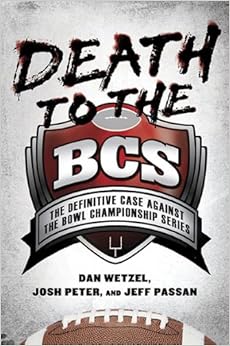
So for those of you unfamiliar with this, about a decade ago I really enjoyed reading the book you see at the header of this post. Wetzel, Peter, and Passan really tore into the old powers that be in college football and, while the current system is better than the corrupt BCS, that's an awfully low bar. I'm more into a model similar to what Division III uses: access to championships across all conferences, and that's exactly the model the authors proposed in their book. A 16 team tournament with automatic bids going to conference champions, and filled out with at large teams works. What makes this model even better is that instead of half-full bowl games with schools getting fleeced, they get to make more money by playing the first three rounds of the tournament on campus, with the title game at the Grandaddy of them All.

So how do we decide this field? Over the past few years I've developed and refined a few different metrics that will assist with data gathering and ultimately, field selection. You will be seeing the following:
  • Advance warning of November's "Nick Saban Is A Coward" Week
    Photo by Rogelio V. Solis (AP)

    Non-Conference Schedule Strength (NCSS)
    : On a weekly basis, I look at the schedule and assign teams a number for their game.
    • Point System
      • -1 point for hosting an FCS opponent
      • 0 points for a bye or playing a conference opponent
      • 1 point for playing a Group of Five team at home or a neutral site
      • 2 points for playing a Group of Five team on the road, or for playing a Power Five team at home or a neutral site
      • 3 points for playing a Group of Five team on the road
    • Obviously, higher numbers means a "tougher" schedule on paper. Usually the Group of Five teams will end up with significantly higher numbers here
    • This is more of a secondary metric; its primary purpose to confirm that no team plays multiple FCS schools in a single season. Playing more than one, except in circumstances of game cancellations forcing a last-minute add, will result in disqualification from the Death to the BCS Playoffs
  • Playoff Points: I borrowed and adjusted this metric from the Illinois High School Association's football playoff qualifying system. This metric comes in multiple forms
    • First Degree Playoff Points (PP1): Basically a "Who did you beat?" question. You receive points equal to the number of wins of each team you beat, and is cumulative for the whole year.
      • In 2019, the top team in this metric was Ohio State with 84 points, and the national average for the season was about 28 points, and among playoff teams the average was 58 points. Note that wins over FCS opponents award no points.
    • Second Degree Playoff Points (PP2): Expands on the first question by adding in context of "How good were the teams you beat, really?" Teams are awarded the number of First Degree Playoff Points the teams they beat have earned, and those totals are averaged per win (e.g. a 10-2 team gets PP1 from all ten teams they beat, and that sum is divided by 10; a 1-11 team's PP2 equals the PP1 of the team they beat.)
      • In 2019, Ohio State led this metric as well with over 32 PP2. The national average was just shy of 16, and among playoff teams the average was close to 24. Again, wins over FCS opponents award no points, which means a zero is included in the calculation of the average for those teams.
    • Adjusted Playoff Points (aPP): Exactly the same as PP1, but taking losses into account. A team that loses has the number of losses by the team that beat them subtracted from their score. Basically something of a "How bad was/were your loss(es)?" question. Obviously, undefeated teams lose no points, and as an added wrinkle, losses to FCS teams count as double (e.g. in 2019, Georgia Tech lost to The Citadel, who went 6-6; Georgia Tech lost 12 aPP from this game.)
      • In 2019, Ohio State obviously led this category as well with 84 points as an undefeated regular season team. To illustrate a better example, take a pair of 10-2 teams in Penn State and Notre Dame. Penn State had 55 PP1 and Notre Dame had 61. Penn State's two losses were to 10-2 Minnesota and 13-0 Ohio State, giving them 53 aPP. Notre Dame's two losses were to 11-2 Georgia and 9-3 Michigan, giving them 56 aPP.
  • Computer Rankings: This comes in later in the season when I start building out brackets. I use three formulas compiled online. These formulas all take margin of victory into account.
    • Jeff Sagarin (He had a formula that was used for the BCS back in the day, but his BCS formula didn't account for margin of victory. The one used for this ranking does.)
    • David Rothman (The late statistician also used to have his ranking incorporated into the BCS until they dumped the margin of victory component was to no longer be considered, and he dropped out of the BCS. His formula is open-source and calculations are compiled by a faculty/staff member at UCLA.)
    • All My Sports Teams Suck (I wanted an additional source and added this ranking later.)
  • Record vs Playoff Teams: This factor was a more recent addition, influenced by regional rankings used in Division III sports. This can be misleading; losses to playoff teams are not a dealbreaker and in fact will often be used to bolster a team's case. All other factors being relatively equal, a 10-2 team whose two losses came to playoff teams may get the edge over a team that went 0-1 or even 1-1 against playoff teams.
Over the next few months, I'm going to try to go back to old patterns of posting once or twice a week, looking over NCSS and Playoff Point scores, comparing by conference every week and linking to the sheet where I tally all of these. As we get closer to playoff time, I may even do some mock brackets again. But following conference championship weekend, I'll go into the lab, look over all this data, and build out the bracket. I may even do some guest assistance with this; we'll see.

This is, however, also the part where I need to make a couple disclaimers. Ohio State was briefly serving an at large suspension due to actions by one of their assistant coaches; that suspension has been served and is thus lifted, so they are fully eligible for the playoffs. However, two schools are not, and if you've been a COAS reader from the beginning, you know who they are. Baylor, due to its coverup of sexual assault by players under Art Briles some time back, is permanently banned from the playoffs despite having made prior appearances. But the other, who has never appeared in the playoff, and never will, is the cult at Penn State. I've said it for years, and I'll say it again: Joe and the administration knew, and when you're a cult that prioritizes football over the well being of children, you don't deserve a football program. Penn State should have gotten the death penalty, and their football stadium and all football-related facilities should be burned to the ground and the earth salted where those places stood.

The season kicks off with a random Big Ten game in about a week for something of a Week Zero, then Week 1 kicks off in full next week. Next week is probably when I'll start with my first NCSS post, and we'll pick it up as the season goes along. Good luck to your teams this season, and I look forward to kicking the Death to the BCS Playoffs back off!

Friday, October 2, 2020

2019 Death to the BCS Playoffs: Fast Forward

We're starting to see something of a return to normalcy now. The Stanley Cup Final is complete, the NBA Finals are underway, the MLB Playoffs are about to begin... and football is more or less in full swing. The NFL has gone on with minimal hitches, and the FBS is starting to get back to normal as some conferences are already playing and others are coming back soon.

This would normally be where I'd be announcing the 2020 Death to the BCS Playoffs. Problem is, given the way the schedules are set up, with different conferences starting later, I don't think it's a fair year or a good year to do the Death to the BCS Playoffs. Fortunately, I still have the 2019 bracket to go through!

I built this bracket out way back in December, when the word "pandemic" wasn't on anyone's mind, North Central was coming off a huge upset of Mount Union en route to a national title, and I was in the midst of a long basketball layoff. Teams were not in on my simulator in time to do the playoff in real time like I had for the first few years, but now that they are, and we're in full swing of football, it's time to attack this again.

You can view the official bracket, which will include final scores when we're done, here. All simulations are provided by WhatIfSports.com. Let's play some football!

Thursday, January 2, 2020

2018 Death to the BCS Playoffs: Fast Forward

I have no idea of the timing of the 2019 Death to the BCS Playoffs, as once again I'm at the mercy of my simulator. But while we're waiting and hoping for that to get started... let's go back in time.

I spent a ton of time waiting for the 2018 teams to pop up as well, and I don't know exactly when they came through, but at some point they did, so I can finally go back and simulate out that postseason.

Like I did last year, instead of doing one post for each round, I'm doing the whole postseason in one go. Higher seeds get home field advantage for the first three rounds, with the title game being played in Pasadena. I will go back and grab weather conditions at kickoff from each location for each game to try and make what would have happened as accurate as possible. With my usual handicapping website that I used for injury updates not helpful for a tournament from a year ago, I'm going to go with standard starting lineups for teams unless I see something on a box score from that team's bowl game from last year that leads me to believe there was an injury at play.

All simulations are provided by WhatIfSports.com. Let's crown a 2018 champion.

Monday, December 9, 2019

2019 Death to the BCS Playoffs: Official Bracket

All right, the conference championships are in the books. Let's build a bracket.

I looked over the title games last week, and tried to picture how I anticipated the at large selection process would end up going. And so after a couple hours of deliberation, we're all set for the 2019 Death to the BCS Playoffs! But how do we take the results of so many college football games and pare this down to 16 teams? And why 16?

I ran with the idea that the authors of the book pictured here proposed almost a decade ago as the ultimate counterargument against the corrupt system that was the BCS. The current College Football Playoff is better, but not perfect in my eyes. There's still a level of corruption by the refusal to acknowledge all of the teams at the FBS level. This playoff fixes that by guaranteeing every conference champion a shot at the national title as every other level of NCAA football does. That's ten spots, and I fill out the field with six at large teams to make the numbers even. The best part? The first three rounds are all played at the home stadiums of the higher seeds; no more three-quarter empty bowl games in random places that rob athletic departments blind.

So how do I decide on the six at large teams who make it, and how do I seed the field? I try to be as impartial as I can, and I do that with a number of metrics outlined below and charted here:
  • Playoff Points: This is an idea that I originally stole from the IHSA. They use a system of adding up the number of wins by opponents on a team's schedule and use that to try and determine a strength of schedule. This metric comes in three forms.
    • First Degree Playoff Points (PP1): The closest to the original idea. For every opponent a team beats, they receive a number of points equal to that opponent's total wins on the season. Those numbers are added for every defeated opponent over the course of a season. As an example, Rutgers went 2-10 on the season with wins over Massachusetts (1-11) and Liberty (7-5), giving them eight PP1 for the year. Obviously, more wins means more chances for points, and wins over better teams means more points from each game. The caveat is that wins over FCS opponents do not award any Playoff Points.
    • Second Degree Playoff Points (PP2): An extension of the original idea. PP1 answers the question to an extent of "How good were your opponents?" PP2 extends on that idea, by taking the mean of the PP1 of defeated opponents. Using the Rutgers example again, they beat Massachusetts, who finished with no PP1, and Liberty, who finished with 14. That gives Rutgers a PP2 of 7.00. More wins will generally mean more points, which I why I factor this metric as a mean rather than a sum total. This will result in some quirks; for example this year Miami (Florida) finished with a PP2 of 28.50 despite finishing 6-6; wins over teams like Virginia and Louisville helped bolster this number for them. Again, wins over FCS teams result in a score of zero for that win, which will drag the average down.
    • Adjusted Playoff Points (aPP): Similar to PP1, except that for every loss by a team, I subtract the losses by their opponent from the total. This is my way to factor in losses as a metric, something not covered by either of the first two metrics. Obviously, losses to really good teams won't hurt, but losses to mediocre or bad teams will hurt worse. Going once again to the Rutgers example, their eight PP1 points still count, but are offset by each of their ten losses. The loss to undefeated Ohio State didn't cost them any points, but a Week 6 loss to 3-9 Maryland cost them nine points just from that game. All told, Rutgers finished with -33 aPP for the 2019 season. Again, wins over FCS teams don't award any points, but losses to FCS teams apply double the loss penalty. This year, there were three losses by FBS teams to visiting FCS opponents. As an example, Central Arkansas went 9-3 in their regular season (I don't count playoff games for this metric), including a win over Western Kentucky. Western Kentucky lost six aPP due to this loss.
  • Computer Rankings: To try and make sure that I'm avoiding any bias, I work other metrics into the fray in the form of computer rankings. While this was a flaw of the BCS, part of the flaw was that margin of victory wasn't factored into theirs. I've found three sets of computer rankings that do, and I average them out to find one average ranking. This ranking is taken from the mean of Jeff Sagarin's rankings, the late David Rothman's rankings, and rankings from All My Sports Teams Suck.
  • Results versus playoff teams: This is a fairly new metric kind of formalizing something I already look at to some degree. It's a metric I look at in stages; initially I start only with the ten conference champions as the playoff teams, and look at records for all the candidates at that time. As I add at large teams, I update the records accordingly before picking the next one. This finalizes when the 16 team field is set and I use it to help with seeding. As a general rule, losses aren't killer, and if you play playoff teams you're likely in better shape than if you don't, even if you lose. Wins over other playoff teams though will certainly help your resume.
I then try to organically combine all these factors when I build out the field. You will see that field seeded 1-16 after the jump, followed by my at large selection process and a rationale for how I seeded the field.

Wednesday, August 21, 2019

College Football and the 2019 Death to the BCS Playoffs

One of the major running features from the first few years of Confessions of a Sportscaster went on hiatus last year. To an extent, it's doing so again.

I had the idea fresh out of college after reading the book pictured here (a masterpiece, in my eyes) to try and implement the playoff system described by Dan Wetzel, Josh Peter, and Jeff Passan. And so starting in 2012, I was tracking results every week, posting them here, and at the end of the season building a playoff bracket based on their system, then simulating it out.

I ran into a problem in 2017; WhatIfSports, my simulator, had gone up for sale and thus teams weren't getting input like they had been so I wasn't able to maintain my usual pattern of posting results. That meant that I didn't do my usual series of tracking results in 2018. Eventually the 2017 teams did enter the simulator and I did run through that playoff. But the 2018 teams didn't get input until months after the college football season ended, so while I tracked the numbers last season and built a bracket, I wasn't able to simulate the postseason in real time. That feature will come sometime this fall or early winter; possibly as an appetizer to the 2019 Death to the BCS Playoffs that will go on... it's just a question of when.

You can click on the above link for last year's bracket to view how I build out the postseason bracket, but the CliffNotes version is this: all ten conference champions get an automatic bid, with six at large bids to fill out the field. I pick those teams and seed everyone based on a number of metrics: one I built myself for non-conference scheduling, one I borrowed from the IHSA (then a couple that derive from it), and a trio of computer rankings that factor margin of victory into the equation. I'll go into more specifics come December after the championship games are in the books and I'm ready to unveil the bracket.

But before I leave it at that for the fall, I also want to make a couple things clear about eligibility, and to an extent this is where my non-conference metric comes in. I've railed against FCS games to some degree; I get their purpose and in the grand scheme of things they don't hurt anybody. But any team that plays two FCS opponents (except in a circumstance where a game gets cancelled and they need to fill it at the last minute with a second FCS team) will be suspended from the postseason. Additionally, a few other teams are also at least partially ineligible for this year. Ohio State, despite Urban Meyer having ridden off into the sunset and the offending assistant having long since been removed, is currently under an at large suspension from the Death to the BCS Playoffs. This means that if they win the Big Ten, they will make it in, but that is their only route to the playoffs; they cannot be considered for an at large bid. This suspension is in effect through the 2020 season, at which point they will regain full eligibility.

The same can't be said for two other programs, and regular readers of Confessions of a Sportscaster will know where I'm going with this. Baylor is permanently banned from the Death to the BCS Playoffs for a pattern of covering up sexual assault cases to protect the football program. Similarly, (and you know this is the big one), Penn State is permanently banned from the Death to the BCS Playoffs for being a cult that prioritized football over the well being of children. I will still calculate their metrics, and games against these teams will still count for the purpose of metric gathering, but they will not be considered for postseason play.

If you are curious to see where your team might stand at any point in the year, you can view that here. I will do my best to update this weekly. Good luck to your teams this fall!

Friday, December 7, 2018

2017 Death to the BCS Playoffs: Fast Forward

We interrupt preparations for the 2018 Death to the BCS Playoffs with a blast from the past. So... remember when I said I was cancelling the Death to the BCS Playoffs? I lied.

In early October, I was making my occasional rounds on WhatIfSports to check to see if teams were getting updated. And finally... the 2017 college football teams were there.

This has me encouraged for the upcoming 2018 Death to the BCS Playoffs, but while we wait for that, I wanted to make sure I had some content for the interim. And since the 2017 teams are on there... let's go back in time and resolve the 2017 postseason.

The link above takes you to my post about the 2017 bracket and my rationales for picking who I did, so I'm not going to go too much into the field. But I will go through the process of simulating the playoffs. Normally I go on a week by week basis, but since this should have been played months ago I am simulating the entire postseason in one go.

The simulation process, however, is going to remain largely the same. Higher seeds get home field advantage through the first three rounds, with the title game being played in Pasadena. Weather conditions from the specified game times and dates will be taken into account. In the past, I've used Don Best's handicapping website for making sure injured players aren't in these playoff games, but seeing as we're well past that point his site is useless this season. I will likely just go with the default lineups for this postseason, but I'll try to cross check against bowl game box scores to make sure no one who was out for the year ends up impacting the postseason.

All simulations are provided by WhatIfSports.com, now that they've finally uploaded this year's teams. So, without any further delay, let's start the Death to the BCS Playoffs.

Monday, December 3, 2018

2018 Death to the BCS Playoffs: Official Bracket

I have a few recurring features every year on Confessions of a Sportscaster. My favorite probably far and away is the Pigskin Pick 'Em contest, but this one has to be second on the list. And I apologize in advance, because this post will be long.

I never got into college football growing up, partially because my dad wasn't into it, but there was also the corrupt system of the BCS that played a role. While this book is somewhat out of date, I highly recommend reading it if you haven't; it's extremely enlightening about the extreme flaws with the old system, most exemplified in the LSU-Alabama title game that completely invalidated the 2011 regular season.

Wetzel, Peter, and Passan also built out an alternative playoff format that I love and have used every year since. It's had to be revised since the death of the WAC, but the revision was minor. The authors call for a 16 team playoff that includes every conference champion, plus at large teams to fill out the field. They recommend a selection committee to build the field, but in the absence of one, I've elected to fill the field every year myself.

Photo by Grant Halverson (Getty Images)
To help aid in my quest with picking the at large teams and seeding the bracket, I use a number of metrics to help in my decision. This year I didn't chronicle the weekly changes to these metrics via blog post, but I did keep track of results on a weekly basis. I use three different sets of Playoff Points based off a metric I stole from the IHSA: First Degree Playoff Points (PP1), which is the sum of wins by all the opponents a team defeated; Second Degree Playoff Points (PP2), which takes the mean of PP1 of all opponents a team defeated; and Adjusted Playoff Points (aPP), which is like PP1 but subtracts the sum of losses by opponents who defeated a team. You can view how all those metrics were calculated here.

To ensure that I leave out room for bias, I also take into account three different sets of computer rankings, grabbing the average of the three to get a rough picture. These three rankings all take margin of victory into account: Jeff Sagarin's, the late David Rothman's, and those from the website All My Sports Teams Suck. I will also look at record against other playoff teams starting just with the conference champions and adding in the at large teams as I pick them. This factor will help mostly with seeding, but may also help when I look at picking the at large teams.

So without further ado, here is your field for the 2018 Death to the BCS Playoffs!

Tuesday, November 27, 2018

2018 Death to the BCS Playoffs: Automatic Bid Games

As I promised... the Death to the BCS Playoffs will live on.

I haven't done my two-to-three times a week series of posts on the 2018 college football season because I wasn't sure if my work would end up coming to fruition. But the 2017 college football teams showed up on my simulator, which likely means the 2018 teams are going to be coming as well.

In the interim, I have been continuing to track college football results and update my usual set of metrics. With Conference Championship Weekend approaching, that means the field will soon have its ten automatic bid recipients, and I'll need to pick my six at large teams and seed everyone. But that's getting a little ahead of myself.

As I've done in years past, I will go through the schedule for Week 14, noting that there are some additional games going on based on postponements from the regular season. Those games will get factored into teams' numbers and will obviously impact some things in terms of computer rankings. But the important games... the games that will determine automatic bid winners? Information on those comes after the jump.


Wednesday, August 22, 2018

College Football and the 2018 Death to the BCS Playoffs

It's late August. And that usually means that it's time for me to begin preparations for the upcoming college football season and thus the Death to the BCS Playoffs. It's been one of my favorite projects to undertake over the last several years. But circumstances have changed.

You may remember back in March I wrote a kind of cryptically-titled post on here. And my fears in March have been somewhat confirmed. While there have been updates on WhatIfSports, one of which enabled me to cobble together this year's big project in the second NFL Tournament of Champions, college football has not updated yet. Supposedly the 2017 teams are in the works, but as of August 22nd, those teams are still not live, which gives me little faith that the 2018 teams will be come December.


Monday, December 4, 2017

2017 Death to the BCS Playoffs: Official Bracket

And so after 14 weeks, it has all come down to this. The College Football Playoff field is set, but I needed an extra day with commitments yesterday to process all of the happenings from Championship Saturday and build the field for the Death to the BCS Playoffs.


I'm okay with what the College Football Playoff has done, because it allows for more settling things on the field than the old BCS did. That's why Dan Wetzel, Josh Peter, and Jeff Passan wrote the pictured book tearing the BCS to shreds and offering up their solution, which I've adopted as my hope for the eventual playoff. This is a 16 team field where every conference champion makes it, thus making the regular season more meaningful for more teams and allowing access to all teams. We then fill the field with six at large teams, which for some may seem like a lot, but I think it's a fair number and it makes the bracket even.

So how are these teams decided? Wetzel, Peter, and Passan recommended a selection committee, but in its absence I took on that role singlehandedly, though I didn't do so alone. I use a number of metrics, which are explained to some degree in every mock bracket post but gone into greater detail back in my season introduction post. For your reference, my NCSS and Playoff Points scores can be found here, while the computer rankings can be found here, here, and here.

Armed with this information, and seeing all ten automatic bids awarded, I can build out the playoff field. In the rankings below I'll have each team's record and their relevant scores and rankings. As a new feature, after showing where each team was seeded last week, I will also share how many times each team has made the playoffs before. You can find a full archive of that, along with postseason records by team, conference, and seed, here.

And so, without further ado, here is the official field for the 2017 Death to the BCS Playoffs!

Tuesday, November 28, 2017

2017 Death to the BCS Playoffs: Automatic Bid Games

I started this feature last year, because in Week 14 it's almost all conference championship games, and as such NCSS really won't make any changes. There are a few games where changes will be made, with that said, and you can check my spreadsheet for those updates. A quick survey of my schedule shows that there are all of two games this week that fit that criteria, though I will throw the Army-Navy game in as a feature for this week even though it's a week and a half out. It does count for those metrics.

Speaking of that Army-Navy game, that game won't have any bearing on the playoffs; neither team is in contention for an at-large bid (Navy has five losses, and Army has three without the requisite metrics to overcome them). As such, it thus comes down to a total of twelve games to fill the ten automatic bids. Nine of those are conference title games; I'll go into those games below. The other three are Sun Belt contests, and as the only conference without a championship game, the tiebreakers are once again messy.


Monday, November 27, 2017

2017 Death to the BCS Playoffs: Week 13 Mock Bracket

The playoffs are well underway in every division of college football except the FCS. And now that North Central got bounced badly, I can turn my full attention to basketball and the Death to the BCS Playoffs.

The regular season is over for all but one conference, plus some assorted other games including the Army-Navy game that's not going to have any playoff impact. So with the conference title games taking place this coming weekend, I need to do one final mock bracket.

This is for the playoff system created by Dan Wetzel, Josh Peter, and Jeff Passan in the pictured book where there's a 16 team field: 10 automatic bids to every conference champion, plus six at larges to fill the field. They are seeded 1-16, with home field advantage going to the higher seed for the first three rounds before the title game is held in college football's mecca: Pasadena.

So how do we fill the field, and how is it seeded? Ideally, this would be done by committee, but since we don't have a committee for this, I take that responsibility on, though I don't just do it based on the eye test. I use a number of metrics to help me make the right decision. I glance at Non-Conference Schedule Strength (NCSS) to get a measurement of whether teams are trying to challenge themselves out of their conference schedule (and it also gives me an excuse to call Nick Saban a coward). More importantly, I care about results. That's where First Degree (PP1), Second Degree (PP2), and Adjusted Playoff Points (aPP) come in. Those factor in who you beat, and also a little bit of who they beat as well as the Adjusted points factoring in losses. This helps differentiate between 10-2 teams or 11-1 teams. Finally, to help factor in margin of victory and create a lack of bias, I also look at computer rankings devised by Jeff Sagarin (SAG), the late David Rothman as compiled by a UCLA staff member (ROTH), and from the website All My Sports Teams Suck (AMSTS). These factors, along with factors like head to head victories and wins over other playoff teams combine organically to build the bracket.

And so, with that explanation out of the way, let's look at our final mock bracket for this season.

Monday, November 20, 2017

2017 Death to the BCS Playoffs: Week 12 Mock Bracket

Over in Division III of the NCAA, Saturday was the first round of the playoffs, North Central is still alive as one of the top 16 teams in the country. It's a shame that in reality, a 16 team bracket at the FBS level is nothing more than a pipe dream because of corruption and greed. That's where I'm glad Dan Wetzel, Josh Peter, and Jeff Passan wrote the book pictured here.

In this 2010 (and updated in 2011) classic they tear the old Bowl Championship Series apart piece by piece and introduce their replacement plan, which I've adopted as my pick I'd advocate for: a 16 team field where every conference gets its champion in automatically. The rest of the field is filled with deserving at large candidates, and home field advantage reigns for the first three rounds.

The at large selections and seeding processes are suggested to be done by a committee. Since said committee doesn't exist, I try my best to be the committee and build out this scenario to the best of my ability. To do so, I use a number of metrics. I start with a casual look at Non-Conference Schedule Strength (NCSS), which gives a score based on what that schedule looks like. More points are awarded for road games and/or games against Power Five schools, while teams get penalized for playing down a level, though they don't get soapboxed unless you're one of the five schools full of cowards this past week. More importantly, I look at First Degree, Second Degree, and Adjusted Playoff Points (PP1, PP2, aPP, respectively) as a way of looking beyond records to how good the teams you beat were. Finally, to help reduce bias, and also to factor margin of victory in, I use three sets of computer rankings: Jeff Sagarin's (SAG), those compiled by a UCLA staffer using the late David Rothman's formula (ROTH), and those from the website All My Sports Teams Suck (AMSTS).

These factors all somewhat organically combine to build the field. So without further ado, here is my penultimate 2017 mock bracket.

Monday, November 13, 2017

2017 Death to the BCS Playoffs: Week 11 Mock Bracket

I mentioned it early this morning, but in case you didn't see, chaos reigned during Week 11 of the college season. There was even a little bit in D-III as well, where the playoff brackets are built, North Central won the CCIW's automatic bid, and until they get bounced in a disappointing Round 2 performance by UW-Oshkosh or something to that effect, all is right with the world.

Meanwhile, the selection committee for the College Football Playoff has a tall task on its hands, but not as tall as I've got. They only have to fill four spots; I have to fill 16. Now what helps is that, per the design created by Dan Wetzel, Josh Peter, and Jeff Passan and perfected in the book pictured here, 10 of those spots go to conference champions, the way God and nature intended, yet is perverted by the greed of the big time conference commissioners. So it is that every year I try to take this system built by these authors, and set up a 16 team playoff the way they intend: seeded and on campuses through three rounds.

The trick is how to build the field. Since I don't have the benefit of a selection committee, I use a number of metrics to try and help myself out. To a very minor extent I look at Non-Conference Schedule Strength (NCSS) to see how tough teams made their out of conference schedules. This is mainly just a look at road/home imbalance and how Power Five teams tend to fill their schedules with home games against Group of Five teams (and tomorrow, you get my best rant of the year as to how Nick Saban is a coward). More weight then gets put on First Degree (PP1), Second Degree (PP2), and Adjusted Playoff Points (aPP). This is basically a tabulation of wins of vanquished teams by a given program, then a deeper look at how good those teams actually were, and then an adjustment to factor in losses. Finally, to make sure I get rid of any bias, I also look at three separate computer rankings: Jeff Sagarin's (SAG), the late David Rothman's via a UCLA staff member (ROTH), and from the website All My Sports Teams Suck (AMSTS).

These factors are all kind of organically combined to build the 16 team field that would decide a national champion. After much consideration, as well as some waiting for computer rankings to update while I was working on this, here is the sixth mock bracket of the season.

Monday, November 6, 2017

2017 NCAA Death to the BCS Playoffs: Week 10 Mock Bracket

I think we're down to just four weeks of the college football season left, which means there aren't too many mock brackets left to make. But every week, things seem to keep getting more and more confusing in the college football landscape, which makes building these mocks more and more complicated.

If you're unfamiliar with this playoff system, it's pretty simple. It's an expanded version of what college football currently uses, based on the system outlined by Dan Wetzel, Josh Peter, and Jeff Passan in the book pictured here: 16 team playoff, with each conference champion getting an automatic bid, and higher seeds host for the first three rounds. It enhances the college football regular season by attaching meaning to far more games.

Now, to fill and seed the field, the authors wanted a selection committee, and for the purposes of this series of posts, I take on the mantle of selection committee. But I don't just blindly fill the field. I use a number of metrics to help me make my decisions. I look a little bit at Non-Conference Schedule Strength (NCSS) to see how tough of a non-conference slate teams built. More importantly, I look at results based on how good defeated teams are. That's where First Degree, Second Degree, and Adjusted Playoff Points (PP1, PP2, and aPP, respectively), come into play. Then to reduce any bias on my part, I look at computer rankings from Jeff Sagarin (SAG), the late David Rothman via a UCLA staff member (ROTH), and the website All My Sports Teams Suck (AMSTS). These factors all kind of organically combine to create the seedings.

So, without further ado, let's build another mock bracket!

Monday, October 30, 2017

2017 NCAA Death to the BCS Playoffs: Week 9 Mock Bracket

I think this past weekend was the sort of weekend Dan Wetzel, Josh Peter, and Jeff Passan had in mind when they penned the masterpiece you see to your left. There was a ton of chaos, and so many games with playoff impact were played that invoked said chaos. It's further proof that the playoff system they envisioned enhanced the regular season rather than dilute it.

If you haven't read this book, I highly recommend it. But their basic premise for an ideal playoff is this: 16 teams, with each conference getting an automatic bid for its champion, and the field being filled by deserving at large squads. I love the premise, and as such have tried to fill a bracket with their methodology for the last few years. Here's the best part about it though: higher seeds host for the first three rounds, so we're playing games in iconic stadiums on campus in front of partisan crowds instead of neutral site stadiums that may end up half empty. As such, the regular season really matters, because the difference between a 4 seed and a 5 seed is a second home game.

The tricky part comes in how to fill the field, and then how to seed it. To do that, I use a number of metrics. I begin with a glance at Non-Conference Schedule Strength (NCSS), which is a rough look at how tough of a non-conference slate teams are playing (basically, are they playing road games against Power Five opponents or a bunch of home games against Group of Five teams or FCS opponents). At the end of the day though, results matter. That's where First Degree (PP1), Second Degree (PP2), and Adjust Playoff Points (aPP) come in: they go beyond just a won-lost record and figure out how good the teams they beat truly are. Finally, to help reduce bias on my part and to give additional data points, I consult computer rankings compiled by Jeff Sagarin (SAG), a UCLA staff member using the late David Rothman's formula (ROTH), and from the website All My Sports Teams Suck (AMSTS). These factors all kind of organically combine to build the playoff field.

I'm at the point now where I do a mock bracket every week, at least once I can build it without screwing any undefeated teams out of a spot. With a number of them falling this past week, it may create some at large headaches, but we'll see how it goes!