Showing posts with label brackets. Show all posts

Monday, December 6, 2021

2021 Death to the BCS Playoffs: Official Bracket

And now for one of the most fun features I do on a yearly basis.

The FBS regular season is officially complete, the College Football Playoff has its bracket, which also means it's time to unveil this year's Death to the BCS Playoff bracket!

I spent some time Sunday afternoon finalizing metrics, then spent a bunch of time looking over data points to pick the at large teams, and then seed the field. I'm pretty sure I mentioned this in my season opener, but let's go over the primary criteria one more time.

  • Record. This is a given. An undefeated team is getting in. A one loss team is all but a lock to get in. Two losses puts you in decent shape, but you need help. You get the idea.
  • Playoff Points. This comes in three types.
    • First Degree Playoff Points (PP1). A team receives one point for the number of wins of each opponent they defeat. For example, a two win team that beat a six win team and a one win team would have seven points.
    • Second Degree Playoff Points (PP2). This is the average number of First Degree Playoff Points by each opponent they defeat. Back to that two win team example, the six win team had 20 PP1, and the one win team had zero, resulting in a PP2 for our example team of 10.00.
    • Adjusted Playoff Points (aPP). The same as First Degree Playoff Points, except the number of losses by each opponent that defeated a team is subtracted from the score. As an example, an 11-1 team whose only loss was to an undefeated team would have an identical aPP to their PP1, but an 11-1 team whose lone loss came to a 6-6 team would have six points deducted from their PP1 to calculate their aPP.
  • Computer rankings. Formulas created by Jeff Sagarin (SAG), the late David Rothman (ROTH), and the website All My Sports Teams Suck (AMSTS) are synthesized into an average score, but are also looked at individually.
  • Record versus Playoff Opponents. As opposed to "wins versus playoff opponents;" if you lose to a playoff team that's not necessarily a bad thing. Wins versus playoff teams, obviously, are a better thing, but an 0-1 record against playoff teams is arguably better than a 0-0 mark, all other things being equal. Obviously, this means head to head results come directly into play.
    • IMPORTANT NOTE: This gets recalculated multiple times throughout the process. We start with just the automatic bid teams as being considered, then as each at large team is selected, the numbers get rerun.
Additionally, I do my best to avoid first round rematches unless seedings more or less force my hand (if, say, the 1-16 game would be a rematch but I feel like I can't avoid it without screwing over the #1 seed). Higher seeds host through the first three rounds, before the title game gets played at the Rose Bowl the same night as the national title game. I also want to note from the outset (and if you read the preview for this past week, you'd have seen this), but Baylor is banned from the Death to the BCS Playoffs because they should have gotten the death penalty for covering up sexual assault. Call it the Joe Paterno Rule, as Penn State got banned first.

I'm going to go over the rationale for everything after the jump. In the interest of drama... let's go to the podcast for the bracket reveal.

Thursday, December 2, 2021

2021 Death to the BCS Playoffs: Auto Bid Games and At Large Picture

This is a more recent feature as part of the Death to the BCS Playoff series. Especially since I haven't been doing mock brackets this year, this means this post becomes all the more important.

Championship Weekend is all but upon us. That means ten games to determine ten conference champions, all of whom will get an automatic bid into the Death to the BCS Playoffs. For some, their playoff bid may be a formality, others may need to win that game to ensure they're already in. For still others, this is a game merely for seeding purposes. So many motivations all in play here.

There is one additional game being played this weekend: the makeup of Cal-USC that was postponed due to COVID a few weeks ago. Neither team is in the running for a playoff spot, but that game will have some ancillary effects on playoff contenders (possible additional playoff points).

I'll go into the full playoff criteria when I reveal the playoff field, but to give a general idea of what's going to happen with at large selection, I'm borrowing a process from Division III of the NCAA. They split the country into geographic regions, rank teams in each region, then for at large (what D-III calls "Pool C"), they take the top ranked team from each region that didn't earn an automatic bid and put them "at the table" for selection. They'll pick the best team based on criteria from that group, then the next team up from that region comes to the table. We'll do this for the Death to the BCS Playoffs, except by conference instead of region.

So with that in mind, let's look at the conference title games and what each conference's at large chances are.

Tuesday, December 3, 2019

2019 Death to the BCS Playoffs: Auto Bid Games and At Large Picture

I'm going to take a break from reveling in an all-time upset to look at the highest level of college football as we approach Championship Week.

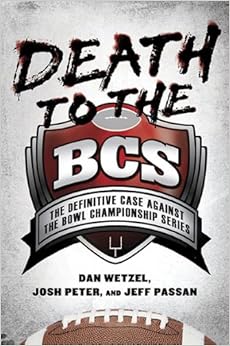
The regular season is finally over and we're onto what are essentially play-in games for the College Football Playoff, but also for the Death to the BCS Playoffs, based off the system proposed in the book pictured here. As I'd hoped, I was able to track results over the course of the entire season and logged my metrics here. I've also, over the past couple weeks, been looking at computer rankings to prepare myself. I haven't officially built a mock bracket yet, but I at least kind of know where I'm going. I just want to get it in writing before the games are played, with the knowledge that computer rankings may change and with new factors getting added that things may end up changing.

But the point of this post, as in years prior, is to look at the upcoming games to determine automatic bids. Most of these are pretty straightforward. One piece I am adding in each entry this year is how at large odds look for each conference. The exact selection method will be explained next week when I build the bracket.


Monday, December 3, 2018

2018 Death to the BCS Playoffs: Official Bracket

I have a few recurring features every year on Confessions of a Sportscaster. My favorite probably far and away is the Pigskin Pick 'Em contest, but this one has to be second on the list. And I apologize in advance, because this post will be long.

I never got into college football growing up, partially because my dad wasn't into it, but there was also the corrupt system of the BCS that played a role. While this book is somewhat out of date, I highly recommend reading it if you haven't; it's extremely enlightening about the extreme flaws with the old system, most exemplified in the LSU-Alabama title game that completely invalidated the 2011 regular season.

Wetzel, Peter, and Passan also built out an alternative playoff format that I love and have used every year since. It's had to be revised since the death of the WAC, but the revision was minor. The authors call for a 16 team playoff that includes every conference champion, plus at large teams to fill out the field. They recommend a selection committee to build the field, but in the absence of one, I've elected to fill the field every year myself.

Photo by Grant Halverson (Getty Images)
To help aid in my quest with picking the at large teams and seeding the bracket, I use a number of metrics to help in my decision. This year I didn't chronicle the weekly changes to these metrics via blog post, but I did keep track of results on a weekly basis. I use three different sets of Playoff Points based off a metric I stole from the IHSA: First Degree Playoff Points (PP1), which is the sum of wins by all the opponents a team defeated; Second Degree Playoff Points (PP2), which takes the mean of PP1 of all opponents a team defeated; and Adjusted Playoff Points (aPP), which is like PP1 but subtracts the sum of losses by opponents who defeated a team. You can view how all those metrics were calculated here.

To ensure that I leave out room for bias, I also take into account three different sets of computer rankings, grabbing the average of the three to get a rough picture. These three rankings all take margin of victory into account: Jeff Sagarin's, the late David Rothman's, and those from the website All My Sports Teams Suck. I will also look at record against other playoff teams starting just with the conference champions and adding in the at large teams as I pick them. This factor will help mostly with seeding, but may also help when I look at picking the at large teams.

So without further ado, here is your field for the 2018 Death to the BCS Playoffs!

Tuesday, November 27, 2018

2018 Death to the BCS Playoffs: Automatic Bid Games

As I promised... the Death to the BCS Playoffs will live on.

I haven't done my two-to-three times a week series of posts on the 2018 college football season because I wasn't sure if my work would end up coming to fruition. But the 2017 college football teams showed up on my simulator, which likely means the 2018 teams are going to be coming as well.

In the interim, I have been continuing to track college football results and update my usual set of metrics. With Conference Championship Weekend approaching, that means the field will soon have its ten automatic bid recipients, and I'll need to pick my six at large teams and seed everyone. But that's getting a little ahead of myself.

As I've done in years past, I will go through the schedule for Week 14, noting that there are some additional games going on based on postponements from the regular season. Those games will get factored into teams' numbers and will obviously impact some things in terms of computer rankings. But the important games... the games that will determine automatic bid winners? Information on those comes after the jump.


Tuesday, November 28, 2017

2017 Death to the BCS Playoffs: Automatic Bid Games

I started this feature last year, because in Week 14 it's almost all conference championship games, and as such NCSS really won't make any changes. There are a few games where changes will be made, with that said, and you can check my spreadsheet for those updates. A quick survey of my schedule shows that there are all of two games this week that fit that criteria, though I will throw the Army-Navy game in as a feature for this week even though it's a week and a half out. It does count for those metrics.

Speaking of that Army-Navy game, that game won't have any bearing on the playoffs; neither team is in contention for an at-large bid (Navy has five losses, and Army has three without the requisite metrics to overcome them). As such, it thus comes down to a total of twelve games to fill the ten automatic bids. Nine of those are conference title games; I'll go into those games below. The other three are Sun Belt contests, and as the only conference without a championship game, the tiebreakers are once again messy.


Monday, November 27, 2017

2017 Death to the BCS Playoffs: Week 13 Mock Bracket

The playoffs are well underway in every division of college football except the FCS. And now that North Central got bounced badly, I can turn my full attention to basketball and the Death to the BCS Playoffs.

The regular season is over for all but one conference, plus some assorted other games including the Army-Navy game that's not going to have any playoff impact. So with the conference title games taking place this coming weekend, I need to do one final mock bracket.

This is for the playoff system created by Dan Wetzel, Josh Peter, and Jeff Passan in the pictured book where there's a 16 team field: 10 automatic bids to every conference champion, plus six at larges to fill the field. They are seeded 1-16, with home field advantage going to the higher seed for the first three rounds before the title game is held in college football's mecca: Pasadena.

So how do we fill the field, and how is it seeded? Ideally, this would be done by committee, but since we don't have a committee for this, I take that responsibility on, though I don't just do it based on the eye test. I use a number of metrics to help me make the right decision. I glance at Non-Conference Schedule Strength (NCSS) to get a measurement of whether teams are trying to challenge themselves out of their conference schedule (and it also gives me an excuse to call Nick Saban a coward). More importantly, I care about results. That's where First Degree (PP1), Second Degree (PP2), and Adjusted Playoff Points (aPP) come in. Those factor in who you beat, and also a little bit of who they beat as well as the Adjusted points factoring in losses. This helps differentiate between 10-2 teams or 11-1 teams. Finally, to help factor in margin of victory and create a lack of bias, I also look at computer rankings devised by Jeff Sagarin (SAG), the late David Rothman as compiled by a UCLA staff member (ROTH), and from the website All My Sports Teams Suck (AMSTS). These factors, along with factors like head to head victories and wins over other playoff teams combine organically to build the bracket.

And so, with that explanation out of the way, let's look at our final mock bracket for this season.

Monday, November 20, 2017

2017 Death to the BCS Playoffs: Week 12 Mock Bracket

Over in Division III of the NCAA, Saturday was the first round of the playoffs, North Central is still alive as one of the top 16 teams in the country. It's a shame that in reality, a 16 team bracket at the FBS level is nothing more than a pipe dream because of corruption and greed. That's where I'm glad Dan Wetzel, Josh Peter, and Jeff Passan wrote the book pictured here.

In this 2010 (and updated in 2011) classic they tear the old Bowl Championship Series apart piece by piece and introduce their replacement plan, which I've adopted as my pick I'd advocate for: a 16 team field where every conference gets its champion in automatically. The rest of the field is filled with deserving at large candidates, and home field advantage reigns for the first three rounds.

The at large selections and seeding processes are suggested to be done by a committee. Since said committee doesn't exist, I try my best to be the committee and build out this scenario to the best of my ability. To do so, I use a number of metrics. I start with a casual look at Non-Conference Schedule Strength (NCSS), which gives a score based on what that schedule looks like. More points are awarded for road games and/or games against Power Five schools, while teams get penalized for playing down a level, though they don't get soapboxed unless you're one of the five schools full of cowards this past week. More importantly, I look at First Degree, Second Degree, and Adjusted Playoff Points (PP1, PP2, aPP, respectively) as a way of looking beyond records to how good the teams you beat were. Finally, to help reduce bias, and also to factor margin of victory in, I use three sets of computer rankings: Jeff Sagarin's (SAG), those compiled by a UCLA staffer using the late David Rothman's formula (ROTH), and those from the website All My Sports Teams Suck (AMSTS).

These factors all somewhat organically combine to build the field. So without further ado, here is my penultimate 2017 mock bracket.

Monday, November 13, 2017

2017 Death to the BCS Playoffs: Week 11 Mock Bracket

I mentioned it early this morning, but in case you didn't see, chaos reigned during Week 11 of the college season. There was even a little bit in D-III as well, where the playoff brackets are built, North Central won the CCIW's automatic bid, and until they get bounced in a disappointing Round 2 performance by UW-Oshkosh or something to that effect, all is right with the world.

Meanwhile, the selection committee for the College Football Playoff has a tall task on its hands, but not as tall as I've got. They only have to fill four spots; I have to fill 16. Now what helps is that, per the design created by Dan Wetzel, Josh Peter, and Jeff Passan and perfected in the book pictured here, 10 of those spots go to conference champions, the way God and nature intended, yet is perverted by the greed of the big time conference commissioners. So it is that every year I try to take this system built by these authors, and set up a 16 team playoff the way they intend: seeded and on campuses through three rounds.

The trick is how to build the field. Since I don't have the benefit of a selection committee, I use a number of metrics to try and help myself out. To a very minor extent I look at Non-Conference Schedule Strength (NCSS) to see how tough teams made their out of conference schedules. This is mainly just a look at road/home imbalance and how Power Five teams tend to fill their schedules with home games against Group of Five teams (and tomorrow, you get my best rant of the year as to how Nick Saban is a coward). More weight then gets put on First Degree (PP1), Second Degree (PP2), and Adjusted Playoff Points (aPP). This is basically a tabulation of wins of vanquished teams by a given program, then a deeper look at how good those teams actually were, and then an adjustment to factor in losses. Finally, to make sure I get rid of any bias, I also look at three separate computer rankings: Jeff Sagarin's (SAG), the late David Rothman's via a UCLA staff member (ROTH), and from the website All My Sports Teams Suck (AMSTS).

These factors are all kind of organically combined to build the 16 team field that would decide a national champion. After much consideration, as well as some waiting for computer rankings to update while I was working on this, here is the sixth mock bracket of the season.

Monday, November 6, 2017

2017 NCAA Death to the BCS Playoffs: Week 10 Mock Bracket

I think we're down to just four weeks of the college football season left, which means there aren't too many mock brackets left to make. But every week, things seem to keep getting more and more confusing in the college football landscape, which makes building these mocks more and more complicated.

If you're unfamiliar with this playoff system, it's pretty simple. It's an expanded version of what college football currently uses, based on the system outlined by Dan Wetzel, Josh Peter, and Jeff Passan in the book pictured here: 16 team playoff, with each conference champion getting an automatic bid, and higher seeds host for the first three rounds. It enhances the college football regular season by attaching meaning to far more games.

Now, to fill and seed the field, the authors wanted a selection committee, and for the purposes of this series of posts, I take on the mantle of selection committee. But I don't just blindly fill the field. I use a number of metrics to help me make my decisions. I look a little bit at Non-Conference Schedule Strength (NCSS) to see how tough of a non-conference slate teams built. More importantly, I look at results based on how good defeated teams are. That's where First Degree, Second Degree, and Adjusted Playoff Points (PP1, PP2, and aPP, respectively), come into play. Then to reduce any bias on my part, I look at computer rankings from Jeff Sagarin (SAG), the late David Rothman via a UCLA staff member (ROTH), and the website All My Sports Teams Suck (AMSTS). These factors all kind of organically combine to create the seedings.

So, without further ado, let's build another mock bracket!

Monday, October 30, 2017

2017 NCAA Death to the BCS Playoffs: Week 9 Mock Bracket

I think this past weekend was the sort of weekend Dan Wetzel, Josh Peter, and Jeff Passan had in mind when they penned the masterpiece you see to your left. There was a ton of chaos, and so many games with playoff impact were played that invoked said chaos. It's further proof that the playoff system they envisioned enhanced the regular season rather than dilute it.

If you haven't read this book, I highly recommend it. But their basic premise for an ideal playoff is this: 16 teams, with each conference getting an automatic bid for its champion, and the field being filled by deserving at large squads. I love the premise, and as such have tried to fill a bracket with their methodology for the last few years. Here's the best part about it though: higher seeds host for the first three rounds, so we're playing games in iconic stadiums on campus in front of partisan crowds instead of neutral site stadiums that may end up half empty. As such, the regular season really matters, because the difference between a 4 seed and a 5 seed is a second home game.

The tricky part comes in how to fill the field, and then how to seed it. To do that, I use a number of metrics. I begin with a glance at Non-Conference Schedule Strength (NCSS), which is a rough look at how tough of a non-conference slate teams are playing (basically, are they playing road games against Power Five opponents or a bunch of home games against Group of Five teams or FCS opponents). At the end of the day though, results matter. That's where First Degree (PP1), Second Degree (PP2), and Adjust Playoff Points (aPP) come in: they go beyond just a won-lost record and figure out how good the teams they beat truly are. Finally, to help reduce bias on my part and to give additional data points, I consult computer rankings compiled by Jeff Sagarin (SAG), a UCLA staff member using the late David Rothman's formula (ROTH), and from the website All My Sports Teams Suck (AMSTS). These factors all kind of organically combine to build the playoff field.

I'm at the point now where I do a mock bracket every week, at least once I can build it without screwing any undefeated teams out of a spot. With a number of them falling this past week, it may create some at large headaches, but we'll see how it goes!

Monday, October 23, 2017

2017 NCAA Death to the BCS Playoffs: Week 8 Mock Bracket

We're still a little over a month away from Championship Saturday, which means I can't fully prepare an actual playoff bracket quite yet. But it's good to get the practice in, and in an alternate universe where this is the actual playoff format, it's good practice for the selection committee. And so, I undertake my third mock of the season.

This is a playoff system outlined in the book pictured to the left, written a few years back by Dan Wetzel, Josh Peter, and Jeff Passan. The premise of the book is simple: the old BCS system of deciding a national champion was elitist, possibly illegal, and patently unfair. So they came up with a fairer one that enhances the regular season: 16 teams, made up of the 10 conference champions (11 when the book was written), with the rest of the field filled by at large selections. They play with home field advantage for the first three rounds, making the season really mean something, and meaning that my seeding of this tournament needs to be perfect.

To help decide the at large teams and seed the field, I look over scores and try to watch games if I can, but because I can't watch every game, I use several metrics to help me out. To a minor degree I check a team's non conference schedule in the form of Non Conference Schedule Strength (NCSS). At the end of the day though, I'm more concerned about results, which is why hopefully you read today's Playoff Points rankings, where I look at First Degree, Second Degree, and Adjusted Playoff Points (PP1, PP2, and aPP, respectively). That's basically a look at win totals of defeated opponents in a few different ways. You can view a full outline of how that metric works in my season introductory post. Then, to ensure that I eliminate any possible bias I may have, I also check three different computer rankings that factor in margin of victory: Jeff Sagarin's (SAG), the late David Rothman's via a UCLA staff member (ROTH), and from the website All My Sports Teams Suck (AMSTS). These factors are all kind of organically combined to build out a bracket, which you can view the newest mock of after the jump.


Monday, October 16, 2017

2017 NCAA Death to the BCS Playoffs: Week 7 Mock Bracket

Last week I had just enough room in my first mock bracket of the season to squeeze in every eligible unbeaten team. And then, go figure, a bunch of them fell like flies.

This complicates the Death to the BCS Playoff picture, even though we still have a good month and a half of season left to play. Teams will separate from the pack a little bit more, and hopefully things will become easier, but in the meantime, I need the practice for bracket building.

So here's a refresher on how this works. The ten conference champions, along with six at large selections, will be seeded 1-16, with higher seeds getting home field advantage for three rounds. To pick out the at large teams and seed the field, I use several of my own metrics, focusing a little on Non-Conference Schedule Strength (NCSS) and more so on First Degree, Second Degree, and Adjusted Playoff Points (PP1, PP2, and aPP, respectively) to help. Then, to help reduce bias, I use computer rankings that factor in margin of victory created by Jeff Sagarin (SAG), the late David Rothman (ROTH), and the website All My Sports Teams Suck (AMSTS). These factors all get kind of organically combined to build the field. The Rothman rankings are up this week, so unlike last week, all three computer rankings will be under consideration.

So without further ado, let's make a mock bracket.

Monday, October 9, 2017

2017 NCAA Death to the BCS Playoffs: Week 6 Mock Bracket

Over the last few years I have come to discover a pattern. By Week 6, enough teams have at least one loss on their resume, which allows me to start thinking about playoff brackets.

The current system set up by the FBS conference commissioners is a decent start. It's a definite improvement over the garbage that was the BCS. If you think the BCS wasn't all that bad, go read the book pictured to the left authored by Dan Wetzel, Josh Peter, and Jeff Passan, then come back and tell me with a straight face that the system was all right. If you do, I will call you a liar, because the BCS was a joke.

And that's what inspired an idea by these three men: building a more equitable playoff for college football, like what is run in the lower divisions of the NCAA. That's basically what I aim to build here.

If you missed my season introductory post where I explained their playoff system, here's the CliffNotes version: 16 teams (all ten conference champions plus six at large) seeded 1-16, with home field advantage granted to the higher seeds for the first three rounds. In their system they had a selection committee, which is a role I've taken by proxy for several years now, and tried to build a bracket based on their specifications.

To do that, I use a number of metrics. To a minor degree, Non-Conference Schedule Strength (NCSS) gets factored in, though its impact is minimal when it comes to filling and seeding the field. More important are First Degree, Second Degree, and Adjusted Playoff Points (PP1, PP2, and aPP, respectively), which dig beyond the won-loss record to get an idea of just how good a team actually is.

Now, I don't want to appear biased, so I also use computer rankings to help me determine if I'm making the right choices, but the computer rankings need to be good. I have found three that factor in margin of victory, which is kind of important when we're trying to figure out how good teams actually are. For the purposes of the Death to the BCS Playoffs, I use Jeff Sagarin's (SAG) model, the late David Rothman's (ROTH) model as compiled by a UCLA faculty member, and the rankings from All My Sports Teams Suck (AMSTS). Currently the Rothman model has no data for 2017, so I'm sticking with just the Sagarin and All My Sports Teams Suck models for now, which is enough to start.

These factors all kind of organically combine to build the field of 16, which will be built out below.

Monday, December 5, 2016

2016 Death to the BCS Playoffs: Official Bracket

Ladies and gentlemen, it has all come down to this.

14 weeks and hundreds of games have narrowed down the 128 teams in college football. The ten conferences have crowned their champions. All that remains is to take them, and six deserving at large teams, and put them into a bracket to determine our national champion.

This is the system designed by Dan Wetzel, Josh Peter, and Jeff Passan in their classic depicted here: a more equitable college football playoff where everyone gets an opportunity to prove they belong. We also add to the excitement and enhance the regular season by giving home field advantage to the higher seeds for the first three rounds.

In their system, a selection committee still decided the field. I don't have those resources at my disposal, so I instead take a number of metrics and use these to help me in my decision making process: rankings of Non Conference Schedule Strength (NCSS), First Degree (PP1), Second Degree (PP2), and Adjusted Playoff Points (aPP), and computer rankings compiled by Jeff Sagarin (SAG), the late David Rothman (ROTH), and the website All My Sports Teams Suck (AMSTS). I organically try to combine all of these to build the fairest playoff bracket that I can.

And so, without further ado, here is your 2016 Death to the BCS Playoff field, seeded from 1-16.

Tuesday, November 29, 2016

2016 Death to the BCS Playoffs: Automatic Bid Games

Tuesday is normally my day of looking at NCSS rankings for college football. But at this point, we are done with all non-conference games, and this coming week is the slowest week in terms of college football games. However, this is a critical week for the Death to the BCS Playoffs.

Of our ten conferences at the FBS level, eight of them are large enough to accommodate conference championship games (and we'll have a ninth next year because the morons running the Big 12 decided to invalidate the regular season with one in a ten-team conference). The winners of seven of these games will receive automatic bids to the Death to the BCS Playoffs. The Big 12 doesn't have an official title game yet, but has a de facto one this year. And finally, the Sun Belt has a couple games that will impact the playoff picture.

So below, I will outline every game that impacts these automatic bids and how they play out with regards to the Death to the BCS Playoffs.

Monday, November 28, 2016

2016 Death to the BCS Playoffs: Week 13 Mock Bracket

And now we get down to the nitty gritty.


I'm still in a state of mourning, but I'll get over it. Wheaton deserved its win on Saturday. And so did all of the teams who won this past weekend as the Death to the BCS Playoff race gets even more complicated.

If you're unfamiliar with how this works, the Death to the BCS Playoffs are the brainchild of Yahoo! writers Dan Wetzel, Josh Peter, and Jeff Passan. They created a 16 team playoff at the highest level of college football, where all conference champions get an automatic bid, and the rest of the field is filled with at large teams. Those auto bids will all be settled next week: eight conference have a conference championship game, the Big 12 has a de facto championship game based on how the schedule aligned, and the Sun Belt will come down to a couple games and some tiebreakers to determine its champion.

From there, the field gets seeded from 1 to 16, with home field advantage going to the higher seeds for the first three rounds. This means finishing in the top two will net you three home games, a #3 or #4 seeds gets you a pair, and finishing in the top eight gives you one in the first round. These figures all assume, of course, that chalk gets rocked. But how do we decide the seeding? Wetzel, Peter, and Passan's idea was for a selection committee to do so, but in my case, I do it myself with the help of some metrics. I use (to an extent) Non Conference Schedule Strength (NCSS), First Degree (PP1), Second Degree (PP2), and Adjusted Playoff Points (aPP), as well as computer rankings compiled by Jeff Sagarin (SAG), the late David Rothman (ROTH), and the website All My Sports Teams Suck (AMSTS). These metrics all organically combine to build the exact playoff field.

And so, for the final time this season: let's create a mock bracket.

Monday, November 21, 2016

2016 Death to the BCS Playoffs: Week 12 Mock Bracket

With the chaotic part of the week out of the way, it's time to sort through the craziness and establish a pecking order.

The D-III playoffs saw chalk advance, and a battle for the fate of the universe will take place in Naperville on Saturday as North Central gets a rematch with Wheaton in Round 2. Meanwhile, several teams are still fighting at the FBS level for conference championships and a berth in the Death to the BCS Playoffs.

This is a concept created by Dan Wetzel, Josh Peter, and Jeff Passan several years ago, where instead of the BCS nonsense or the slightly improved, but in their eyes not quite there College Football Playoff, the Death to the BCS Playoff system is a 16 team field where every conference champion gets an automatic bid, and the rest of the field is filled with at large berths. The field is then seeded 1-16, with home field advantage given to the higher seeds in the first three rounds.

I credit them for this because it was originally their idea. They wanted a selection committee to select the teams and seedings. I've chosen for a few years to take their system and fill the field based on a little bit of the eye test on my part, as well as some metrics chosen to help remove any bias I may have. You will see listed after each team in this field a set of stats. I use Non-Conference Schedule Strength (NCSS), First Degree (PP1), Second Degree (PP2), and Adjusted Playoff Points (aPP) as well as computer rankings compiled by Jeff Sagarin (SAG), the late David Rothman (ROTH), and the website All My Sports Teams Suck (AMSTS), and organically combine all of these to build that 16 team field.

So without further ado, let's build a mock playoff field.

Monday, November 14, 2016

2016 Death to the BCS Playoffs: Week 11 Mock Bracket

Wow. Okay, now comes the fun part.

Since Week 6, I've been building mock brackets for this year's Death to the BCS Playoffs. It's been a relatively easy ride so far, but things are about to become much more complicated given all of the losses this past week. It's meant a tradeoff of first place teams in multiple conferences and it will require a rearranging of at large teams going in.

If you're unfamiliar with how this works, it's pretty simple. The Death to the BCS Playoffs is the brainchild of Yahoo! writers Dan Wetzel, Josh Peter, and Jeff Passan. They created a more equitable college football playoff system (where the current system is an improvement, but not enough of one) where we have a 16 team field. 10 of the spots go automatically to the champions of each FBS conference, then the rest of the field is filled with at large bids. The 16 teams are seeded and set up in a standard bracket. Home field advantage for the first three rounds goes to the higher seeded team, so getting a top eight seed guarantees you home field in round one, a top four seed guarantees it for two rounds, and a top two seed means you won't have to leave home until the title game in Pasadena.

So how do we decide the at large teams, and what's the seeding process? In my borrowing of their system, I work as the sole member of a selection committee, but I use multiple metrics to help build the field. The decisions are made with seven metrics in mind: Non Conference Schedule Strength (NCSS), First Degree (PP1), Second Degree (PP2), and Adjusted Playoff Points (aPP), and computer rankings compiled by Jeff Sagarin (SAG), the late David Rothman (ROTH), and the website All My Sports Teams Suck (AMSTS). These metrics kind of organically mesh together, with the computer rankings inserted to help offset any bias I may have while also bringing margin of victory into play.

So with all of this in mind, after much thought, here is the latest mock bracket for the Death to the BCS Playoffs.

Monday, November 7, 2016

2016 Death to the BCS Playoffs: Week 10 Mock Bracket

The undefeated team count remains at five after ten weeks, but it doesn't make building the Death to the BCS Playoffs bracket any less complicated.

I'm doing a week by week mock of the tournament following every week, beating out the College Football Playoff committee by several weeks, in a series of practice exercises for the real thing following the end of the regular season.

The methodology behind this is pretty simple. The Death to the BCS Playoffs are a 16 team playoff field designed by Dan Wetzel, Josh Peter, and Jeff Passan where all conference champions get an automatic berth to the playoffs, and the rest of the field is filled in with at large teams. While their format had a committee selecting the field, I form a committee of one, albeit a semieducated one who tries to compile a number of metrics to help make an educated decision.

Using Non-Conference Schedule Strength (NCSS), First Degree (PP1), Second Degree (PP2), and Adjusted Playoff Points (aPP), as well as computer rankings from Jeff Sagarin (SAG), the late David Rothman (ROTH), and All My Sports Teams Suck (AMSTS), I will seed the field from 1-16. Home field advantage for the first three rounds goes to the higher seeds, and the championship game is played at the Rose Bowl in Pasadena. Let's see what the latest mock road to Southern California maps out as.