We're into the full swing of conference play, and the Sun Belt seems to be aiming to steal some of MACtion's thunder here in October. But MACtion doesn't come for another few weeks, so I guess it's all okay.
Last week saw a rare week of a conference getting a negative score with the Big Ten's lone non-conference game being an FCS game for Indiana. It's kind of late in the season for it, but it's not quite to the level of Nick Saban Is A Coward Week, which I will hype up until it comes. This week, there shouldn't be another negative week as far as I know... at least, I hope not. If you need a refresher on how this metric works, you can read that in my season introductory post.
The (mostly) sane rantings of a broadcasting graduate working in sports.
Tuesday, October 10, 2017
Monday, October 9, 2017
2017 NCAA Death to the BCS Playoffs: Week 6 Mock Bracket
Over the last few years I have come to discover a pattern. By Week 6, enough teams have at least one loss on their resume, which allows me to start thinking about playoff brackets.
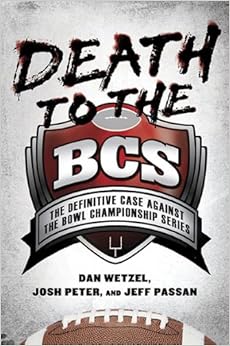
The current system set up by the FBS conference commissioners is a decent start. It's a definite improvement over the garbage that was the BCS. If you think the BCS wasn't all that bad, go read the book pictured to the left authored by Dan Wetzel, Josh Peter, and Jeff Passan, then come back and tell me with a straight face that the system was all right. If you do, I will call you a liar, because the BCS was a joke.
And that's what inspired an idea by these three men: building a more equitable playoff for college football, like what is run in the lower divisions of the NCAA. That's basically what I aim to build here.
If you missed my season introductory post where I explained their playoff system, here's the CliffNotes version: 16 teams (all ten conference champions plus six at large) seeded 1-16, with home field advantage granted to the higher seeds for the first three rounds. In their system they had a selection committee, which is a role I've taken by proxy for several years now, and tried to build a bracket based on their specifications.
To do that, I use a number of metrics. To a minor degree, Non-Conference Schedule Strength (NCSS) gets factored in, though its impact is minimal when it comes to filling and seeding the field. More important are First Degree, Second Degree, and Adjusted Playoff Points (PP1, PP2, and aPP, respectively), which dig beyond the won-loss record to get an idea of just how good a team actually is.
Now, I don't want to appear biased, so I also use computer rankings to help me determine if I'm making the right choices, but the computer rankings need to be good. I have found three that factor in margin of victory, which is kind of important when we're trying to figure out how good teams actually are. For the purposes of the Death to the BCS Playoffs, I use Jeff Sagarin's (SAG) model, the late David Rothman's (ROTH) model as compiled by a UCLA faculty member, and the rankings from All My Sports Teams Suck (AMSTS). Currently the Rothman model has no data for 2017, so I'm sticking with just the Sagarin and All My Sports Teams Suck models for now, which is enough to start.
These factors all kind of organically combine to build the field of 16, which will be built out below.
The current system set up by the FBS conference commissioners is a decent start. It's a definite improvement over the garbage that was the BCS. If you think the BCS wasn't all that bad, go read the book pictured to the left authored by Dan Wetzel, Josh Peter, and Jeff Passan, then come back and tell me with a straight face that the system was all right. If you do, I will call you a liar, because the BCS was a joke.
And that's what inspired an idea by these three men: building a more equitable playoff for college football, like what is run in the lower divisions of the NCAA. That's basically what I aim to build here.
If you missed my season introductory post where I explained their playoff system, here's the CliffNotes version: 16 teams (all ten conference champions plus six at large) seeded 1-16, with home field advantage granted to the higher seeds for the first three rounds. In their system they had a selection committee, which is a role I've taken by proxy for several years now, and tried to build a bracket based on their specifications.
To do that, I use a number of metrics. To a minor degree, Non-Conference Schedule Strength (NCSS) gets factored in, though its impact is minimal when it comes to filling and seeding the field. More important are First Degree, Second Degree, and Adjusted Playoff Points (PP1, PP2, and aPP, respectively), which dig beyond the won-loss record to get an idea of just how good a team actually is.
Now, I don't want to appear biased, so I also use computer rankings to help me determine if I'm making the right choices, but the computer rankings need to be good. I have found three that factor in margin of victory, which is kind of important when we're trying to figure out how good teams actually are. For the purposes of the Death to the BCS Playoffs, I use Jeff Sagarin's (SAG) model, the late David Rothman's (ROTH) model as compiled by a UCLA faculty member, and the rankings from All My Sports Teams Suck (AMSTS). Currently the Rothman model has no data for 2017, so I'm sticking with just the Sagarin and All My Sports Teams Suck models for now, which is enough to start.
These factors all kind of organically combine to build the field of 16, which will be built out below.
2017 NCAA Playoff Points Rankings: Week 6
Saturday saw a lot of chaos in college football, which I love. It means that the order of things gets thrown out of wack, and forces everyone to look differently at the playoff picture.
I'm not quite there yet, because after last week, there were still too many undefeated teams to build out a mock playoff bracket. That may change after today, but I need to run the numbers to be sure.
Below I will run through the average win totals for each conference, plus the independents collected as their own "conference" for the purposes of these rankings. I will also update the Playoff Point totals and give each conference average for those as well. A primer on how exactly these metrics work can be found here.
I'm not quite there yet, because after last week, there were still too many undefeated teams to build out a mock playoff bracket. That may change after today, but I need to run the numbers to be sure.
Below I will run through the average win totals for each conference, plus the independents collected as their own "conference" for the purposes of these rankings. I will also update the Playoff Point totals and give each conference average for those as well. A primer on how exactly these metrics work can be found here.
Thursday, October 5, 2017
2017 COAS Pigskin Pick 'Em Week 5
I had a good week last week as the coalition continued its quest to correctly pick NFL games against the spread. Unfortunately, Adam was better for the fourth straight week. He took three of our five disputed games... and even that took a ridiculous finish for me to salvage a second one. But more on that in a bit.
Through 63 games and four weeks I currently sit in third place in the coalition thanks to my dad having back to back awful weeks. Adam sits in first place a game ahead of Geoffrey Clark, who has gone hero eight times and gotten seven of them right. You can view a full breakdown of our picks in relation to each other here. You can also check our full standings page here, just bear in mind that Adam has two more correct games than what ESPN says he does based on his picks here.
This week, we're onto the byes so there are fewer points up for grabs. Adam and I disagree on six games of the fourteen on the docket. Let's get to it!
Through 63 games and four weeks I currently sit in third place in the coalition thanks to my dad having back to back awful weeks. Adam sits in first place a game ahead of Geoffrey Clark, who has gone hero eight times and gotten seven of them right. You can view a full breakdown of our picks in relation to each other here. You can also check our full standings page here, just bear in mind that Adam has two more correct games than what ESPN says he does based on his picks here.
This week, we're onto the byes so there are fewer points up for grabs. Adam and I disagree on six games of the fourteen on the docket. Let's get to it!
Tuesday, October 3, 2017
2017 NCAA NCSS Rankings: Week 6
We're officially playing games in October now, which means we're well into the college football season. Conference play is also largely underway at this point, which means there's not much left for me to do in this one.
However, there are still the independent teams who need to play games, and we have the occasional interconference game that takes place. We also still have Nick Saban Is A Coward Week and Rivalry Week on the docket, where some major changes will take place.
But for now, I'm going to look at the schedule for this upcoming week and make whatever adjustments to each school's NCSS score, then average them out by conference. I will highlight all non-conference games with each league's score below.
If you need a refresher on how this metric works, it is explained in my season introductory post.
However, there are still the independent teams who need to play games, and we have the occasional interconference game that takes place. We also still have Nick Saban Is A Coward Week and Rivalry Week on the docket, where some major changes will take place.
But for now, I'm going to look at the schedule for this upcoming week and make whatever adjustments to each school's NCSS score, then average them out by conference. I will highlight all non-conference games with each league's score below.
If you need a refresher on how this metric works, it is explained in my season introductory post.
Monday, October 2, 2017
COAS Hands Out 2017 MLB Awards
We interrupt the mostly football-related postings on Confessions of a Sportscaster to bring you another annual feature that I like to do, because running through stats is fun, especially when you don't have to do all the compiling.
It was a pretty busy summer for baseball here on COAS, as I spent the spring and summer working on a much more massive Tournament of Champions than I'd attempted in years prior, but it all worked out in the end when after 1,422 games the 2016 Chicago Cubs took home the Championship of Champions. I'm also hoping that the 2017 Cubs can pull off a repeat and give me a bonus title on top of the one from last year.
But before they can do that, and before any playoff games taint the sample, I want to go through the 2017 Major League Baseball season and, as I have done in years past, make my votes for the four most major awards in each league.
It was a pretty busy summer for baseball here on COAS, as I spent the spring and summer working on a much more massive Tournament of Champions than I'd attempted in years prior, but it all worked out in the end when after 1,422 games the 2016 Chicago Cubs took home the Championship of Champions. I'm also hoping that the 2017 Cubs can pull off a repeat and give me a bonus title on top of the one from last year.
But before they can do that, and before any playoff games taint the sample, I want to go through the 2017 Major League Baseball season and, as I have done in years past, make my votes for the four most major awards in each league.
2017 NCAA Playoff Points Rankings: Week 5
Five weeks are in the books, and with another week completed it's time to take a look at the results.
Last week was the final week of mass non-conference games as pretty much all of the Power Five leagues have begun conference play in earnest. I'll have more about the non-conference schedules tomorrow.
Below I will rank the average scores in terms of wins and the various Playoff Points numbers for each conference through five weeks. If you need a refresher of how these metrics work, you can view that in my season introductory post.
Last week was the final week of mass non-conference games as pretty much all of the Power Five leagues have begun conference play in earnest. I'll have more about the non-conference schedules tomorrow.
Below I will rank the average scores in terms of wins and the various Playoff Points numbers for each conference through five weeks. If you need a refresher of how these metrics work, you can view that in my season introductory post.
Subscribe to:
Posts (Atom)